


Written with Jacob Schaal, subscribe to his blog here. All opinions are our own and do not reflect those of our employers.
The current version reflects research available through Ocotber 2026.
In a previous post, Alex and Soumitra Shukla argued that exposure indices alone cannot predict labor market displacement. This post reviews the empirical evidence on whether there are signs of displacement and, if so, where it is occurring. We should stress that the article is a “now-cast” in the sense that it is meant to reflect how AI is impacting the economy right now rather than forecast potential disruption in the future.
We’re going to review the impact of AI on the labor market with a focus on early-career workers. The more important lagging indicators, unemployment and layoffs, have hardly shown any effect of AI in the labor market so far: the impact of AI on the overall labor market has been consistently muted. At the same time, there is some evidence of impact on entry-level hiring. Even this evidence is mixed, however, with Nordic data showing no reduction in entry-level hiring, and some surveys showing similar null (or even positive) effects across the distribution. Additionally, recent evidence on remote work complicates causal interpretations of exposure-based designs lacking pre-trend and WFH controls. The main unresolved question is whether the observed declines in junior hiring reflect generative AI itself, remote work, post-pandemic labor-market normalization, or some combination of these factors.
The best current evidence supports a narrow claim: AI may already be affecting the hiring margin for junior white-collar roles most exposed to AI, but this attribution is contested, and aggregate labor-market disruption has yet to appear in the data. AI usage data, such as Google’s AI & Economy ATLAS (Alex contributed to ATLAS), may help explain why: Workers adopt AI broadly across occupations, but actual use is still fairly shallow relative to its potential in the given tasks.
Tracking Labor Market Disruption
What data will we be using to assess disruption? First, it’s useful to distinguish between two kinds of data sources (employee vacancies vs. employment stocks) and two kinds of AI measures (exposure vs. adoption). Vacancy data are early but noisy; employment stocks of payroll data are cleaner but lag. Meanwhile, exposure measures capture where AI could matter but don’t distinguish between replacing or helping workers in some tasks and are potentially vulnerable to confounding from remote work. Adoption measures might capture relative effects, e.g., when adopting firms gain market share at the expense of non-adopters. Consequently, AI adopting firms might grow their employment while overall employment in the sector falls. Adopters might also systematically differ from non-adopters, e.g., in their adoption of other innovative tools. These differences explain why the literature can simultaneously show contested effects on junior hiring, weak aggregate employment effects, and contested attribution to AI.
Why focus on early-career hiring in the first place? Early-career hiring may be an early warning sign, a canary in the coal mine. Early-career workers are typically responsible for simpler, lower-context tasks within a firm. As AI systems become more capable, these are the tasks that would be automated first. Juniors also rely more on supervision and learning by doing, and their tasks are more codifiable and easier to review.
Economist David Deming posits that AI affecting only juniors can’t be stable, as long as AI’s capabilities don’t stagnate between juniors and seniors. He also believes that remote work and AI interact: Remote work ensures that some jobs become fully digital. These were the first ones where AI could be fully adopted without stigma around its use and with an extensive data trail. In his analogy, remote work containerized office work, paving the way for AI to automate digital task bundles. Remote work also raises supervision costs, while these supervisors can use AI to do work previously delegated downward.
Looking ahead, forecasters believe the wave will gradually hit the labor market, with the US labor force participation rate predicted to fall from 62% to 58% by 2050 and the recent graduate underemployment rate rising from 41% to 55% by 2035. These forecasts suggest that compared with other large-scale risks mentioned in the International AI Safety Report, broad automation seems less imminent. At the same time, the amount of epistemic uncertainty on how AI will interact with the labor market should make one cautious about interpreting forecasts. Much of AI’s impact on the economy will depend on both the growth in technological capability (which we believe will be fast and massive) and the complexity of the economic system. Realized economic changes may lag technology capabilities suggested due to, for example, slow organizational adoption or because automated and non-automated tasks may be interlinked in “Messy Jobs” as Garicano, Li and Wu argue in a new book with the same name.
Early cracks, contested causes
Here is an overview of the papers we’ll be going through. While the signal in the right column summarizes the headline findings, as the more thorough review will show, a lot is hidden in the details.
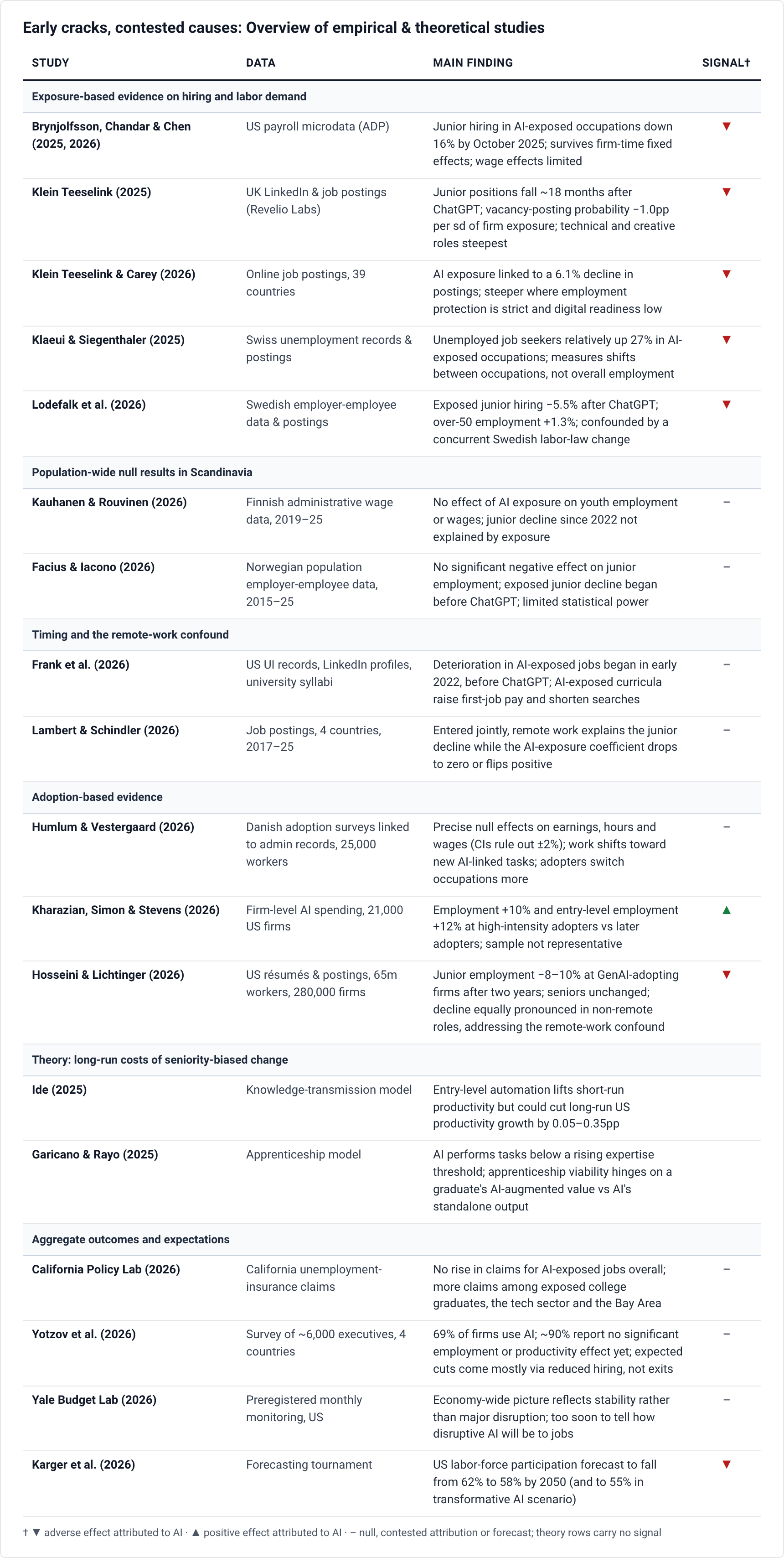
AI exposure predicts reduced junior hiring
Brynjolfsson et al. (2025) was one of the first papers in this space to use high-frequency U.S. payroll microdata from ADP, linked to occupational AI exposure measures, to study how AI influences junior-level employment and wage trajectories. Their “Canaries in the Coal Mine” working paper tracks early-career hiring dynamics following the release of ChatGPT in late 2022, finding a 13% decline in junior employment in high-exposure roles by July 2025. At the same time, the paper finds limited short-term effects on wages, attributing this divergence to structural wage stickiness or countervailing productivity gains from AI.
The initial paper received criticism that macroeconomic shifts—such as interest rate hikes or firm-level post-pandemic overhiring—could explain the reduction in junior hiring after ChatGPT’s introduction. The authors followed up with a research note (Brynjolfsson et al., 2026) incorporating stringent firm-time fixed effects to absorb shocks that affect workers within a firm equally, though occupation-specific shocks remain unabsorbed. In this specification, AI exposure is associated with reduced junior employment starting in 2024, and the cumulative effect is larger than in the initial paper (16% by September 2025 vs. 13% by July 2025) and ongoing. The authors interpret this post-2024 divergence as inconsistent with macroeconomic factors alone explaining the decline. In the latest version of the paper, however, these within-firm estimates attenuated with an improved data pipeline, and the authors now emphasize the simpler descriptive divergence.
The authors have also launched a Canaries Dashboard that regularly updates these employment trajectories by AI exposure. The latest data through summer 2026 shows continued divergence between early-career and more senior workers, with employment of 22–25-year-olds in high-exposure roles 19% below where it would be had it kept pace with less-exposed peers by June 2026, up from 15% at the July 2025 data vintage. The gap roughly halves when controlling for occupational education levels, and the authors treat these patterns as descriptive rather than causal.
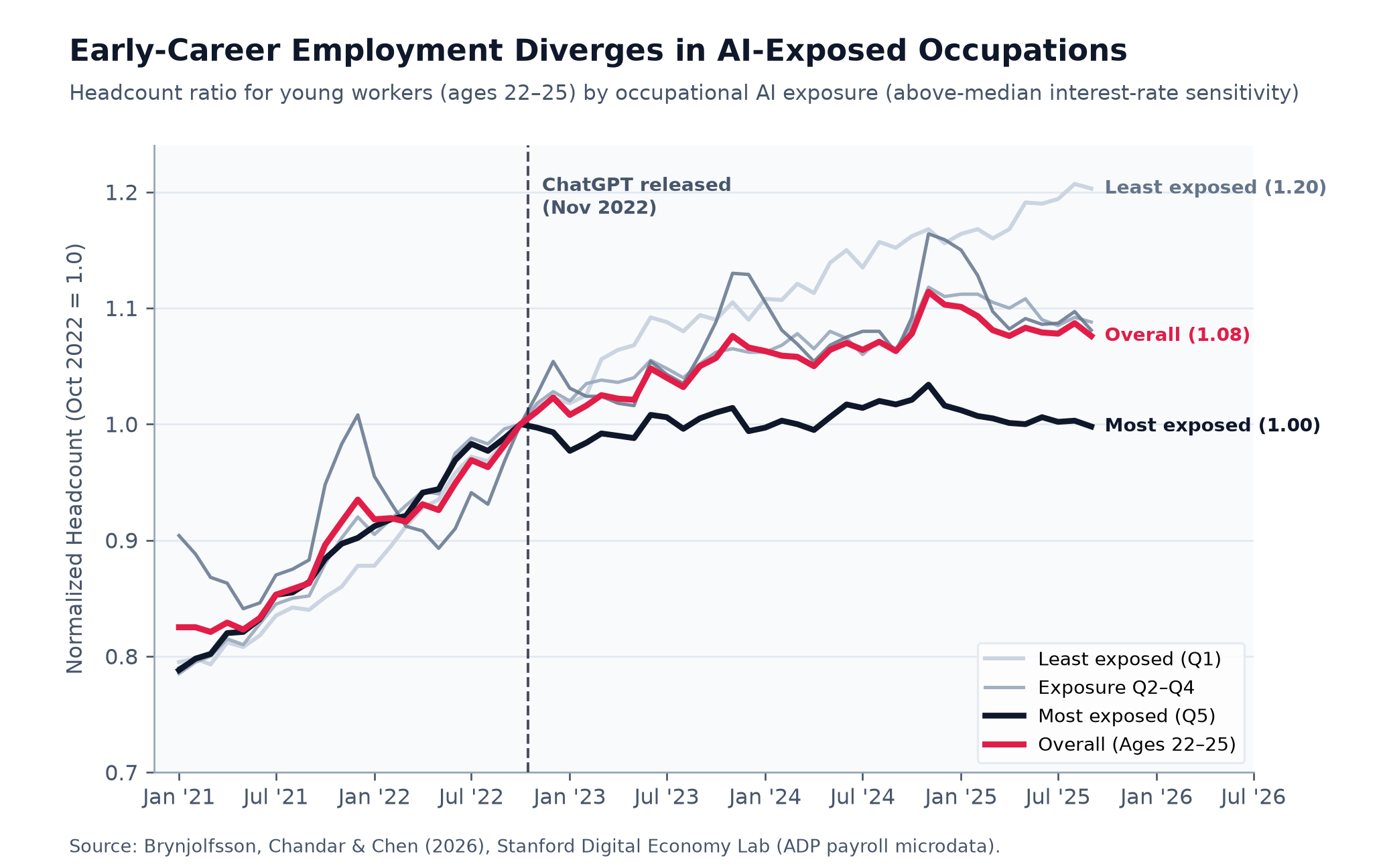
Changes in early-career employment by AI exposure, for occupations with above median interest rate exposure (Brynjolfsson et al., 2026)
Tucker (2026) replicates the Canaries’ finding in Census data covering nearly all private-sector employment, mapping occupational AI exposure onto industries. In the most exposed fifth of industries, hires of 22–24-year-olds dropped by about 9% right after ChatGPT’s release and haven’t recovered. This drove a 12.4% relative fall in early-career employment by mid-2025. However, compared with prime-age workers in the same industries, young workers were already slipping from the pandemic onward, consistent with remote work or longer schooling. Monetary policy shocks explain at most a quarter of the employment gap. Tucker suggests firms paused junior hiring out of uncertainty about AI rather than because they were using it.
In a companion paper, Orr, Tucker and Warren (2026) follow 6.7 million bachelor’s graduates into Census employment records, assigning AI exposure by college major. Graduates of the most exposed tenth of majors, mostly computer science, became 5 percentage points less likely to be employed right after graduation. Their initial earnings fell about 13%, similar to graduating into a recession. Half of the earnings loss comes from starting in lower-paying sectors such as retail and restaurants. Controlling for remote work barely changes the results, although remote work and AI exposure are highly correlated across majors. Rising self-employment and graduate-school enrollment could explain up to half of the employment drop.
Klein Teeselink (2025) uses Revelio Labs LinkedIn and job-posting data from the UK to show a reduction in junior hiring, using ChatGPT as a natural experiment. A one-standard-deviation increase in the firm-level AI exposure score is associated with a reduction in junior positions, with effects emerging approximately 18 months post-treatment. Hiring intentions respond more rapidly: exposed firms reduce the probability of posting a vacancy by 1.0 percentage point, with technical and creative roles experiencing the steepest declines. He also uses firm-by-period fixed effects, estimated separately by seniority level.
Does the effect of AI differ across the globe?
In a follow-up paper with the same job posting data, Klein Teeselink and Carey (2026) investigate the influence of AI exposure on labor demand across 39 countries, using hundreds of millions of online job postings as a measure of labor demand. Their study finds that AI exposure is linked to a 6.1% decline in job postings, particularly in countries with stricter employment protection and lower digital readiness.
Demirev (2026) adds European evidence using CEDEFOP online job postings for EU countries from late 2021 to mid-2025. Across five exposure measures, postings fell 19–29% more in the most exposed occupations than in the least exposed. However, the timing is a concern. The pre-ChatGPT reference window covers all of 2022, and much of the relative decline appears before ChatGPT's release, in line with the late-2022 tech downturn. Controls for interest-rate sensitivity and remote work cut two of the estimates roughly in half. The CEDEFOP series also fell far more than other vacancy data, so the author treats these magnitudes as an upper bound.
Klaeui and Siegenthaler (2025) provide further evidence for AI’s reallocation of jobs away from AI-exposed occupations in Switzerland. The study constructs an event study using official unemployment records and job postings and finds that unemployed job seekers increase by 27% in AI-exposed occupations relative to less-exposed ones, suggesting that AI negatively affects knowledge-intensive workers. But they only measure shifts between occupations, not overall employment effects.
Lodefalk et al. (2026) also use job postings from Sweden’s largest recruitment platform to show that AI exposure is associated with a shift toward a higher share of senior roles, while leaving total employment unaffected. The broad decline in job postings aligns with interest rate hikes, which started in Sweden 7 months before ChatGPT. They use extensive Swedish employer-employee data in an event study. After ChatGPT, AI-exposed junior hiring falls by 5.5 percent, while over-50-year-olds saw a 1.3 percent increase in employment. This reallocation would be partly consistent with seniority-biased technological change if there weren’t a serious identification threat: Sweden signed a new labor protection law starting in October 2022 that requires staffing firms to offer permanent contracts after 2 years of employment. This change in the law might reduce junior hiring at the same time that ChatGPT enters the labor market and poses a serious threat to identification.
Thus, the junior displacement finding replicates across the US, UK, Switzerland, and Sweden, though identification strategies and confounds differ across settings.
Few canaries in Nordic population-wide employment data
Nordic population-wide data doesn’t detect adverse effects of AI exposure on young people’s employment levels, but doesn’t feature more rapidly changing hiring flows.
Kauhanen and Rouvinen (2026) find no effect of AI exposure on wages and employment among Finnish youth, using administrative wage data from 2019 to 2025. While junior employment has fallen modestly since 2022, senior employment has grown strongly, and this isn’t due to AI exposure. When mapping US exposure scores to the Finnish workforce, only 79% of workers have an exposure score, potentially attenuating estimates. The authors suggest that demographic factors play a larger role in Finland and that the country differs in various respects, e.g., in employment protection.
Facius and Iacono (2026) find no significant negative effect on junior employment using Norwegian administrative employer-employee data. Their data covers the entire population from 2015 to March 2025 and suggests that junior employment in AI-exposed occupations began to decline before ChatGPT. While this study couldn’t detect a small negative effect of AI, it suggests that other factors affecting the labor market before 2022 might have played a role, such as remote work.
Hernæs and Kostøl (2026) extend the Norwegian evidence to February 2026, using the universe of private-sector employment. Employment in the most AI-exposed occupations has grown 0.1% since October 2022, against 0.3% in the least exposed, an insignificant gap. Young software developers fell about 18%, but young workers in the most exposed quintile don't fall behind the least exposed, including within firms. For 22–25-year-olds, however, a gap opens from spring 2025, just as Facius and Iacono's data end. Parallel pre-trends are rejected in every age group, so neither the null nor the late gap is well identified.
Does AI exposure or remote work better explain the timeline of the labor market impact?
Frank et al. (2026) use multiple U.S. datasets, such as monthly unemployment insurance records to measure occupation-location unemployment risk, millions of LinkedIn profiles to track entry into AI-exposed jobs, and millions of university syllabi to measure “AI-exposed curricula.” They find that unemployment risk in AI-exposed occupations rose beginning in early 2022, before ChatGPT’s release. LinkedIn data show graduate cohorts from 2021 onward entered AI-exposed jobs at lower rates than earlier cohorts, with gaps opening before late 2022. At the same time, after ChatGPT, graduates taking more AI-exposed curricula have higher first-job pay and shorter job searches. Some “AI-exposed” labor-market deterioration may reflect pre-existing trends.
Lambert and Schindler (2026) challenge the converging literature that AI might have caused the reduction in junior hiring. Remote work is strongly correlated with AI exposure, since both are most strongly associated with white-collar, computer-intensive knowledge work. WFH increases supervision costs for juniors and reduces their learning when they can’t look over seniors' shoulders, according to the authors.
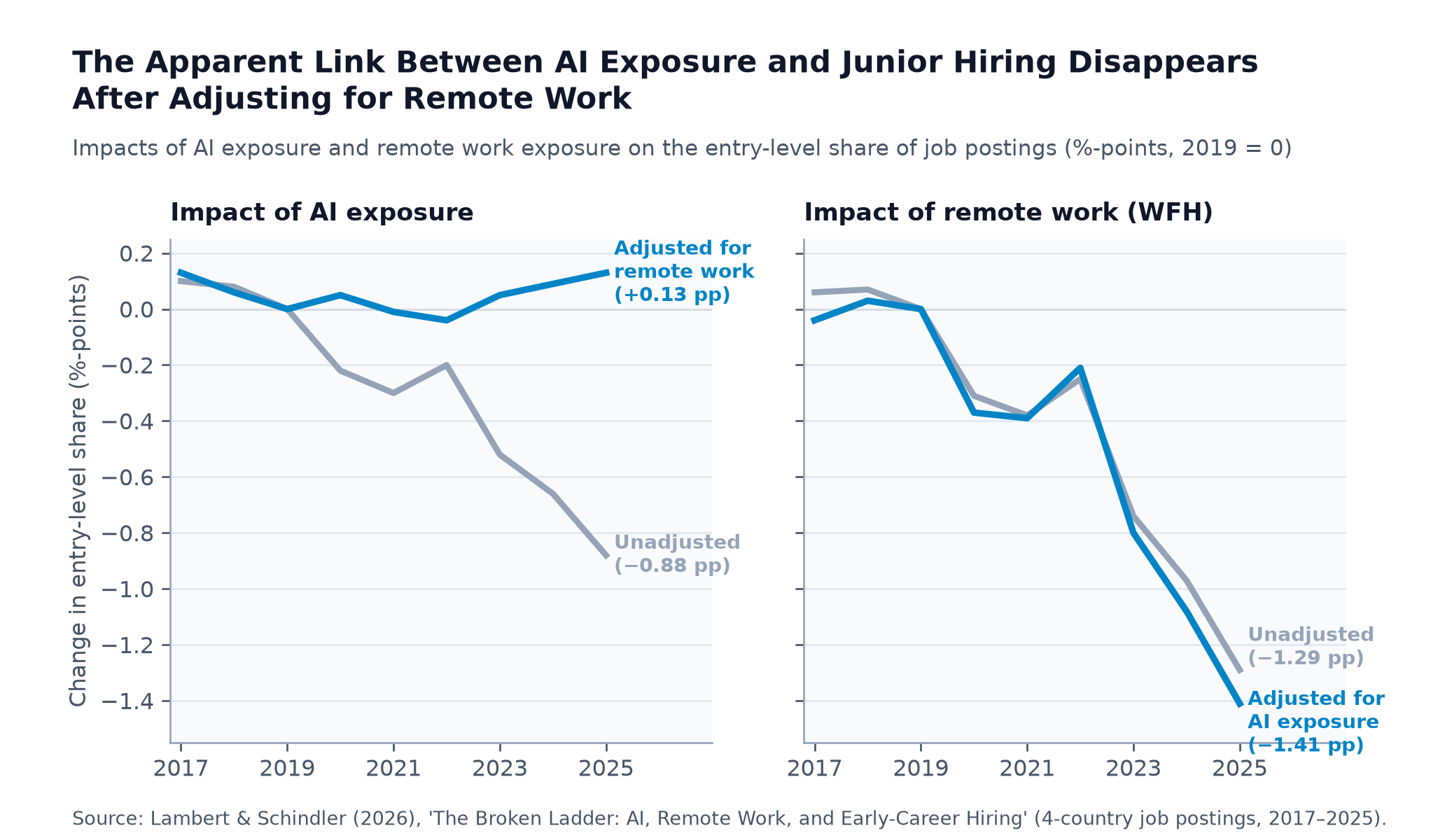
Junior hiring started to fall during the pandemic, but fell off a cliff in 2022. When you look at how AI exposure or working from home (WFH) affects the fall in the junior share over time in job posting data from 4 countries from 2017–2025, they can explain similar magnitudes even after controlling for all fixed differences between firms and occupations, as well as for common shocks over time. Entered jointly, the WFH coefficient hardly changes, while the coefficient for AI exposure drops to zero or even flips positive. Extensive robustness checks, including measurement-error simulations and various AI exposure measures, confirm this. This holds for both WFH exposure and actual WFH adoption from job ads.
At the same time, Hosseini and Lichtinger (2026) offer evidence for AI’s negative impact with a different adoption measure and account for remote work. They create a measure of AI adoption for firms from job posting data and find a seniority-biased technological change. Using data from 65 million workers across 280,000 firms (2015–2025), they identify firm adoption of generative AI (GenAI) through text analysis that detects job postings featuring “GenAI integrators”. Following adoption, junior employment declines by 8–10% in adopting firms relative to non-adopters after 2 years, while senior employment remains largely unchanged. The junior decline is concentrated in occupations most exposed to GenAI and appears to be driven by slower hiring rather than by separations or promotions. In the most recent version, Hosseini and Lichtinger respond directly to concerns about remote work: the junior decline at AI-adopting firms appears to be equally pronounced in positions unsuited to remote work. Brynjolfsson et al. (2026) also rerun Lambert and Schindler's specification on ADP payroll data and find the opposite: entered jointly, the AI exposure gradient on the junior share of new hires survives and grows, while the remote-work gradient shrinks. Because the specification is identical, they attribute the difference to the data (LinkedIn profiles and job postings versus payroll records), and possibly to measuring seniority by role rather than by age.
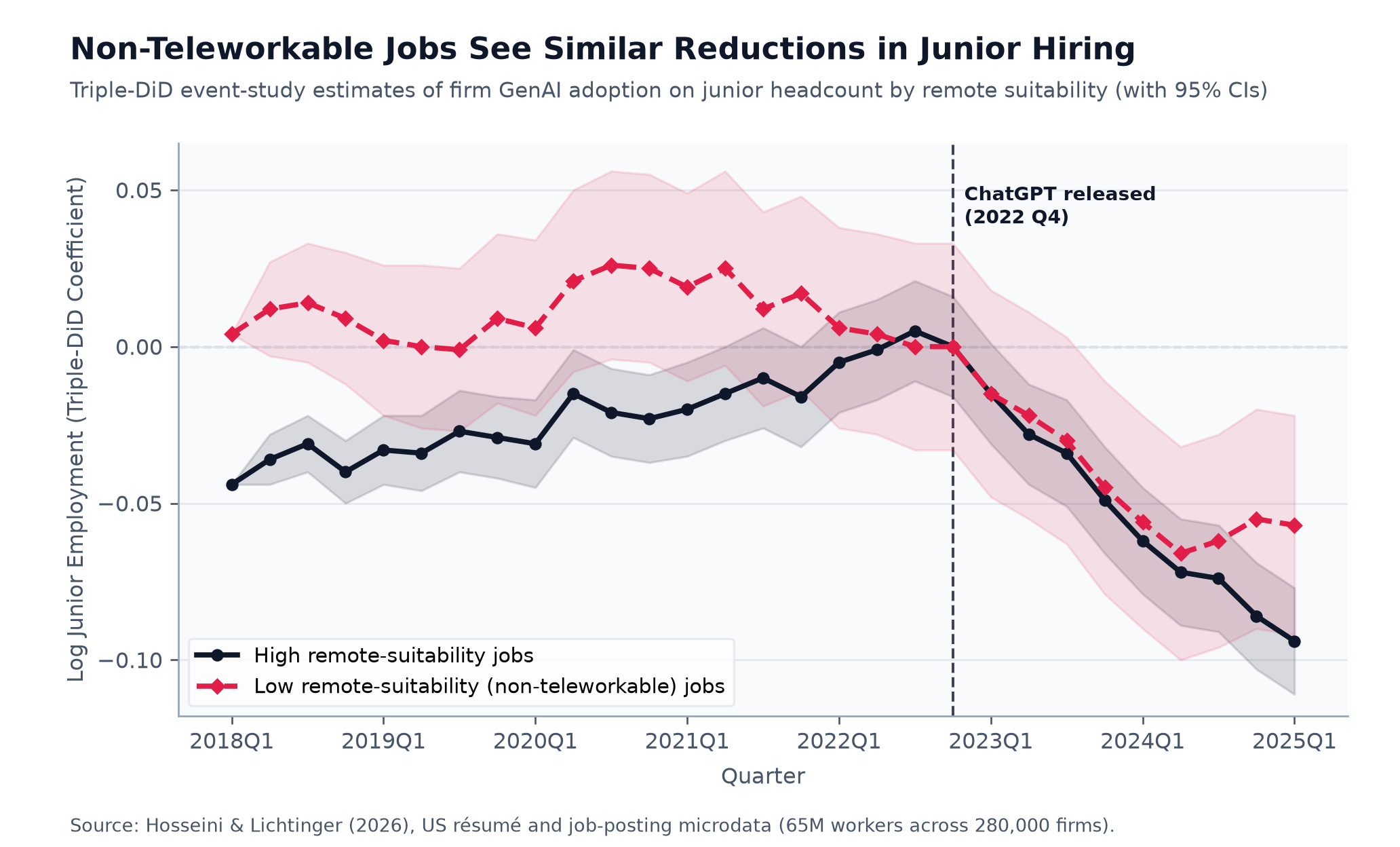
Non-teleworkable jobs see similar reductions in junior hiring after ChatGPT.
Overall, these papers suggest that while remote work remains a serious contender among many potential factors linked to both AI and employment outcomes, its role in completely explaining the early career results is still uncertain. One possible interpretation is interaction: remote work weakened supervision and made work more digital; AI, in turn, became easier to deploy in precisely those workflows.
What does AI adoption data suggest about its impact?
Henseke (2026) bridges the gap between exposure-based and adoption-based literature. Using the 2024 European Working Conditions Survey, the paper maps occupational AI exposure to worker-reported AI use at work. Exposure predicts adoption, but less so after controlling for, e.g., gender, education, abstract task content, and digital work.
Humlum and Vestergaard (2026) linked large-scale adoption surveys to administrative labor market records for 25,000 workers across 7,000 workplaces in 11 AI-exposed occupations in Denmark. Despite 93 percent of workers in firms with enterprise chatbots and training reporting they used AI at work, difference-in-differences estimates show null effects on earnings, recorded hours, and wages. Confidence intervals rule out effects larger than 2 percent two years after ChatGPT’s launch. Still, about 8 percent of chatbot users report taking on entirely new tasks (rising to 17 percent in firms with active employer initiatives), spanning content generation, AI oversight, and AI integration into workflows. Adopters are significantly more likely to switch occupations, working about 4 percent of a full-time equivalent more in their most recent occupation by December 2024, and those who switch move into roles with higher wage premia, seeing earnings grow 12 percentage points faster. At the workplace level, firms encouraging chatbot use show no differential changes in employment, wage bills, or hiring composition, including among early-career workers.
Kharazian, Simon and Stevens (2026) link observed firm-level AI spending to workforce records for 21,000 US firms. They find that employment grows by 10% among high-intensity-adopting firms and by 12% for entry-level employment, compared to not-yet adopters that will later spend similar sums on AI per employee. Low-intensity adopters show no statistically significant change in employment. The sample isn’t representative, and firms spending more per employee on AI may be those with better management, stronger product-market fit, or venture financing. Additionally, adopters might take market share from more non-adopting labor-intensive firms, which could offset these within-firm gains in aggregate.
Chandar and Klein Teeselink (2026) extend the adoption approach to 41 countries using LinkedIn job postings and profiles. They compare foreign affiliates of multinationals that post generative AI jobs with similar affiliates of non-adopters. They instrument adoption with AI uptake among other multinationals headquartered in the parent company’s city. By March 2026, adoption lowered the junior share of employment by 1.9 percentage points. Unlike in Hosseini and Lichtinger, this mostly reflects more seniors (+6.7%) rather than fewer juniors (−2.5%, insignificant). The junior share fell in 23 of 31 countries. But these are effects relative to non-adopters, not economy-wide, and LinkedIn over-represents professionals.
What long-term consequences could seniority-biased technological change have?
Economists have started to outline the negative implications of seniority-biased labor market disruption on the transmission of knowledge within the firm. Ide (2025) develops a model that features short-run productivity gains from entry-level role automation, but also reduced skills among future generations. Back-of-the-envelope calculations show that this could reduce US GDP growth by 0.05 to 0.35 percentage points over the long run. Similarly, Garicano and Rayo (2025) develop an apprenticeship model in which AI performs tasks below a rising threshold of expertise, while experts may complement AI. The ratio between the AI-augmented value of a graduate relative to AI’s standalone output determines the feasibility of an apprenticeship system. If seniority-biased technological change persists, these theoretical models predict long-run costs.
Aggregate stability currently coexists with subgroup displacement
While there is some compelling evidence of negative labor market effects for early career workers in AI-exposed roles, there has been little evidence of aggregate AI-driven displacement. Executives cite AI as a major reason for layoffs, but only 1% of laid-off workers attribute their firing to AI, according to Gallup. Guy Berger (Burning Glass Institute) and Matt Darling (MEF) recently presented convincing descriptive statistics showing that neither high-frequency data nor overall layoff data shown below indicate much AI impact so far. Recent data from California adds more nuance: While AI-exposed jobs haven’t seen an increase in unemployment insurance uptake, AI-exposed college grads, the tech sector, and the Bay Area now feature more unemployment claims. This reinforces the central pattern: aggregate stability can coexist with early stress in exposed subgroups.
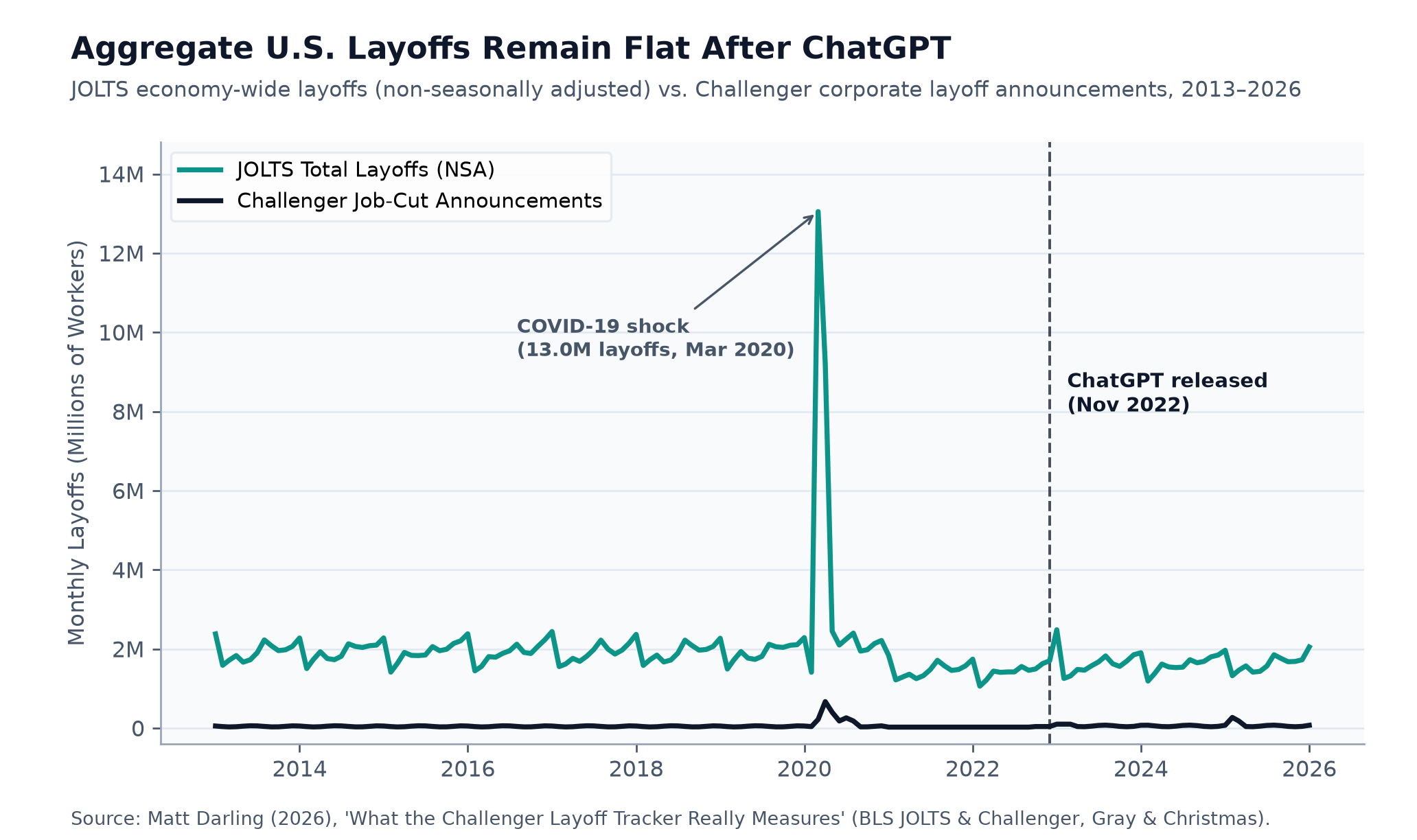
Source: Darling
Fairlie and Wu (2026) take a descriptive look at the class of 2026 using CPS microdata through August 2026. Because graduate unemployment always spikes in summer, they compare summer 2026 with earlier summers. Unemployment among 22–25-year-old college graduates averaged 7.3%, within the 6.3–7.8% range of 2022–25, and didn't rise relative to older graduates or young non-graduates. Counting graduates who want a job but aren't searching gives 10.4%, the highest of five summers, though not significantly so. The small sample can't rule out rises of 2–3 percentage points. And a sharp drop confined to a few exposed majors, as in Orr, Tucker and Warren, would barely move this average.
Yotzov et al. (2026) survey nearly 6,000 executives on their AI adoption in the US, the UK, Germany and Australia. 69% of firms report using AI, while around 90% say AI hasn’t affected overall employment or productivity significantly so far. But executives and employees differ in their outlook on AI’s impact over the next 3 years: While executives expect productivity gains and employment reductions, employees expect AI to boost employment. Among a UK subsample of firms expecting employment reductions, roughly two-thirds of the anticipated reduction is expected to come from reduced hiring rather than exits. This may explain why current employees don’t expect negative effects. The null effects on current employment are also consistent with the results so far: a small reduction among junior hires would not materially affect total headcount.
The end of Yale’s Budget Lab write-up summarizes this well: “The picture of AI’s impact on the labor market that emerges from our data largely reflects stability rather than major disruption at the economy-wide level. While generative AI looks likely to join the ranks of transformative, general-purpose technologies, it is too soon to tell how disruptive the technology will be to jobs. The lack of widespread impacts at this early stage is not unlike the pace of change in previous periods of technological disruption. Preregistering areas where we would expect to see the impact and continuing to monitor monthly impacts will help us distinguish rumor from fact.”
Another way to monitor AI’s impact is through AI companies' usage data. Google’s ATLAS shows that US workers adopt AI broadly, covering 88% of US employment, but only 21% of tasks in the observed jobs. Such shallow adoption is consistent with little automation of full workflows so far. Anthropic's usage data points the same way: Massenkoff and McCrory (2026) find that even in the most exposed occupations, automative uses make up only part of AI’s use, though they don’t measure adoption depth.
ATLAS usage patterns also shed light on the mechanism of reduced junior hiring. Non-routine cognitive tasks are heavily overrepresented, especially those involving low expertise. If AI replaces workers in low-expertise tasks within an occupation, this would imply higher wages and lower employment in these roles, according to the expertise framework of Autor and Thompson (2025). If junior roles focus on low-expertise tasks, this is consistent with lower junior hiring.
Apart from early career workers in exposed fields, the impact of AI on the labor market has thus far been muted. That being said, it would be unwise to assume that this trend will continue. Adoption of agentic AI into enterprise workflows is in its infancy, and many bottlenecks remain. Significant disruption may thus begin to appear in the data as bottlenecks are broken and adoption continues at pace; the trends that currently seem to be present in exposed junior hiring may then begin to radiate through the rest of the labor market.
But there are also forces pushing in the other direction. Messy jobs—ones where tasks are difficult to unbundle—will resist automation and may even expand as AI integration increases. Both existing and potentially new regulation will protect many roles from disruption. Importantly, just as has been the case for every other technological transformation, we are likely to see the emergence of new jobs. For example, the relational sector—where human involvement in the role is part of the value—may expand as labor flows to existing relational jobs (e.g., healthcare, education) and new jobs are created. Additionally, we have already started to see an inflection point in entrepreneurial activity, with Stripe declaring the huge increase in AI-enabled startups as evidence for a singularity. Human-led, AI-run small firms may become a significant driver of future employment, as lower entry costs make it profitable to serve unmet latent demand and niche markets.
We’d like to thank Dan Carey, Rhea Karty, Bouke Klein Teeselink, Bharat Chandar, and Tom Cunningham for feedback.
Other review articles
Buerkli (2026) summarizes AI’s labor market impact in graphs.
Chandar (2025) interprets his own and related research.
Del Rio-Chanona et al. (2025) also trace the history of labor economics models and focus on productivity effects.
Rinehart (2025) covers empirical estimates from a broader range of topics.
References
Autor, David, and Neil Thompson. "Expertise." Journal of the European Economic Association 23, no. 4 (2025): 1203–1246 (NBER Working Paper No. 33941).
Bengio, Yoshua, et al. "International AI Safety Report 2026." International AI Safety Report (February 2026).
Berger, Guy. "High Frequency Labor Market Indicators (3/19)." Macro Mostly (March 2026).
Brynjolfsson, Erik, Bharat Chandar, and Ruyu Chen. "Canaries in the Coal Mine? Six Facts about the Recent Employment Effects of Artificial Intelligence." Stanford Digital Economy Lab Working Paper (August 2025; revised August 2026).
Brynjolfsson, Erik, Bharat Chandar, and Ruyu Chen. "Canaries, Interest Rates, and Timing: More on Recent Drivers of Employment Changes for Young Workers." Stanford Digital Economy Lab (February 2026).
California Policy Lab. "Tracking AI-Related Job Loss Using Unemployment Insurance Claims Data in California." California Policy Lab / California Employment Development Department (June 2026).
Challenger, Gray & Christmas. "April 2026 Challenger Report: Job Cut Announcements." Challenger, Gray & Christmas (May 2026).
Chandar, Bharat, and Bouke Klein Teeselink. “How Does AI Change Labor Demand? Evidence from 41 Countries.” SSRN Working Paper No. 7498743 (September 2026).
Darling, Matt. "What the Challenger Layoff Tracker Really Measures." Best Trousers (March 2026).
Deming, David. "Remote Work Containerized the Office, Paving the Way for AI." Forked Lightning (June 2026).
Demirer, Mert, John J. Horton, Nicole Immorlica, Brendan Lucier, and Peyman Shahidi. "Chaining Tasks, Redefining Work: A Theory of AI Automation." NBER Working Paper No. 34859 (February 2026).
Demirev, Georgi. "AI and the Composition of Labor Demand: Evidence from Online Job Postings" SSRN Working Paper No. 7054839 (July 2026; revised September 2026)
Facius, Dennis, and Roberto Iacono. "Labor Market Consequences of Generative AI." CESifo Working Paper No. 12752 (June 2026).
Fairlie, Robert, and Jane Wu. "The Early Impacts of AI on Employment among Recent College Graduates." NBER Working Paper No. 35796 (September 2026).
Federal Reserve Bank of New York. "The Labor Market for Recent College Graduates." Federal Reserve Bank of New York (2026).
Frank, Morgan R., Alireza Javadian Sabet, Lisa Simon, Sarah H. Bana, and Renzhe Yu. "AI-Exposed Jobs Deteriorated before ChatGPT." arXiv:2601.02554 (January 2026).
Gallup (James, Mary Page, and Ryan Pendell). "U.S. Workers Continue to Report Downsizing." Gallup Workplace (June 2026).
Gans, Joshua S., and Avi Goldfarb. "O-Ring Automation." NBER Working Paper No. 34639 (January 2026).
Garicano, Luis, Jin Li, and Yanhui Wu. Messy Jobs: The Work That AI Cannot Reach (2026).
Garicano, Luis, and Luis Rayo. "Training in the Age of AI: A Theory of Apprenticeship Viability." CEPR Discussion Paper No. 20634 (September 2025).
Henseke, Golo. "Generative AI at Work: From Exposure to Adoption across 35 European Countries." arXiv:2604.18849 (April 2026).
Hernæs, Øystein, and Andreas Ravndal Kostøl. “Has AI Widened Employment Gaps? Tracking Early-Career Employment by Occupational Exposure in Norway.” RFBerlin Discussion Paper No. 179/26 (July 2026).
Hosseini Maasoum, Seyed Mahdi, and Guy Lichtinger. "Generative AI as Seniority-Biased Technological Change: Evidence from U.S. Résumé and Job Posting Data." SSRN Working Paper No. 5425555 (August 2025; revised June 2026).
Humlum, Anders, and Emilie Vestergaard. "Large Language Models, Small Labor Market Effects." NBER Working Paper No. 33777 (April 2025; revised March 2026).
Ide, Enrique. "Automation, AI, and the Intergenerational Transmission of Knowledge." IESE Business School Working Paper / arXiv:2507.16078 (July 2025; revised December 2025).
Iscenko, Zanna, Scott Strand, et al. "Google's AI & Economy ATLAS v1.0: Mapping Gemini Usage in the Economy." Google / Google DeepMind (July 2026).
Karger, Ezra, et al. "Forecasting the Economic Effects of AI." NBER Working Paper No. 35046 (April 2026).
Kauhanen, Antti, and Petri Rouvinen. "AI Has Not Impacted the Youth Labor Market in Finland." ETLA Working Papers No. 135 (January 2026).
Kharazian, Ara, Lisa Simon, and Ryan Stevens. "A New Look at AI's Impact on Jobs: Firm-Level AI Spending and Workforce Adjustment." Ramp Economics Lab Working Paper (June 2026).
Klaeui, Jeremias, and Michael Siegenthaler. "KI und der Schweizer Arbeitsmarkt: Erste Evidenz zu Auswirkungen auf Arbeitslosigkeit und Stellenausschreibungen." KOF ETH Zurich (October 2025).
Klein Teeselink, Bouke. "Generative AI and Labor Market Outcomes: Evidence from the United Kingdom." SSRN Working Paper No. 5516798 (September 2025).
Klein Teeselink, Bouke, and Daniel Carey. "AI, Automation, and Expertise." SSRN Working Paper No. 6134506 (January 2026).
Lambert, Peter John, and Yannick Schindler. "The Broken Ladder: AI, Remote Work, and Early-Career Hiring." SSRN Working Paper No. 6787638 (May 2026).
Lodefalk, Magnus, Lydia Löthman, Michael Koch, and Erik Engberg. "Same Storm, Different Boats: Generative AI and the Age Gradient in Hiring." Ratio Working Paper No. 388 (March 2026).
Massenkoff, Maxim, and Peter McCrory. "Labor Market Impacts of AI: A New Measure and Early Evidence." Anthropic (March 2026).
Orr, Cody, Lee C. Tucker, and Lawrence Warren. "Graduating into Disruption: Labor Market Outcomes for AI-Exposed College Majors." U.S. Census Bureau CES Working Paper No. 26-56 (September 2026)
Stripe. "August 2026 Investor Letter." Stripe (August 2026).
Trammell, Philip. "Workflows and Automation." Working Paper (2026).
Tucker, Lee C. "You're (Not) Hired: Artificial Intelligence and Early Career Hiring in the Quarterly Workforce Indicators." U.S. Census Bureau CES Working Paper No. 26-27 (April 2026).
Yale Budget Lab. "Evaluating the Impact of AI on the Labor Market: Current State of Affairs." Yale Budget Lab (regularly updated).
Yotzov, Ivan, Jose Maria Barrero, Nicholas Bloom, Philip Bunn, Steven J. Davis, Kevin M. Foster, Aaron Jalca, Brent H. Meyer, Paul Mizen, Michael A. Navarrete, Pawel Smietanka, Gregory Thwaites, and Ben Zhe Wang. "Firm Data on AI." NBER Working Paper No. 34836 (February 2026).
Any reason you didn't include Fairlie & Wu? https://www.nber.org/system/files/working_papers/w35796/w35796.pdf
I'm not sure any of these studies adequately disentangles "AI exposure" from interest rate exposure.
I read through the article cited by Brynjolfsson et al. on calculating the heterogenous impact of monetary policy on the labor market, and I'm not convinced that it serves as a useful control in regressions on recent industry data. It's long and dull but the upshot is essentially that more automated work/tasks are more subject to interest rate shocks on data, an effect calculated from 1978 to 2019.
However, interest rates sat at or near 0 from 2009 to 2015 and again from 2020 to 2022. These are the only times since 1955 that interest rates have a) sat near 0 and b) sat at the same place for a sustained period of time; yet that period is only a small sliver of the dataset they use for their calculations.
That's a problem, because negative real returns on savings can push more money into speculative investments like tech/start-ups. Global venture funding peaked in 2021 before dropping by 29% from 2021 to 2022 and 34% from 2022 to 2023 according to Deal Room. That drop was caused by the federal reserve announcing the highest rate increases in over a decade, not AI. That drop in venture funding is disproportionately impacting information technology focused companies, yet the "interest rate exposure" control Brynjolfsson et al. is using a calculation that ranks information technology heavy professions as relatively low in interest rate exposure. The actual interest rate exposure of these information focused professions is actually going to be highly correlated with AI automation exposure right now.