


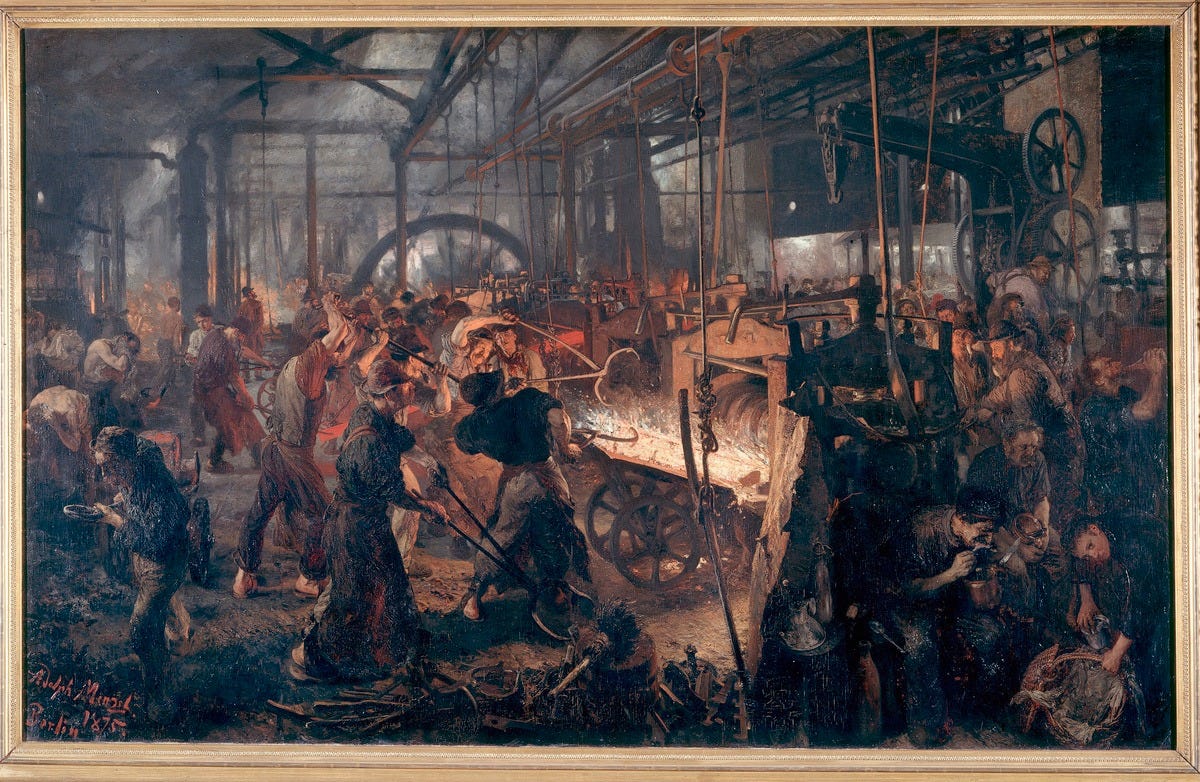
Technological change has historically been a very personal event for people. Over the history of technological progress, looms have fallen silent, switchboards have gone dark, and factory lines have shrunk, bringing with them a human crisis of identity and questions about what it means to be a master of one’s craft.
The goal of this essay is to present a historical record of technological change and the anxieties around it, not to propose a solution to today’s concerns. In this essay, we trace that history from 1750 to the present day. While job loss has often been a primary focus of reactions to technological development, the threat to a deeper sense of self built around hard-earned expertise has also been a recurring concern.
We will start in the early years of the Industrial Revolution with the spinning jenny, move on to the Luddites in the 1810s, and explore debates about craftsmanship and creativity in much of the 1800s. We will then traverse the 20th century, covering the rise of assembly lines, telephone and elevator operators, and modern computers. We will close by focusing our attention on developments in the 21st century, covering automated sportswriting, AlphaGo, the Hollywood writers’ strike, and AI’s advances in mathematics. As we see echoes of history in present-day mathematicians expressing their unease about rapid developments in AI, it is helpful to reflect on what it has meant to be a human and a skilled worker over the last 250+ years.
Machines and Livelihoods
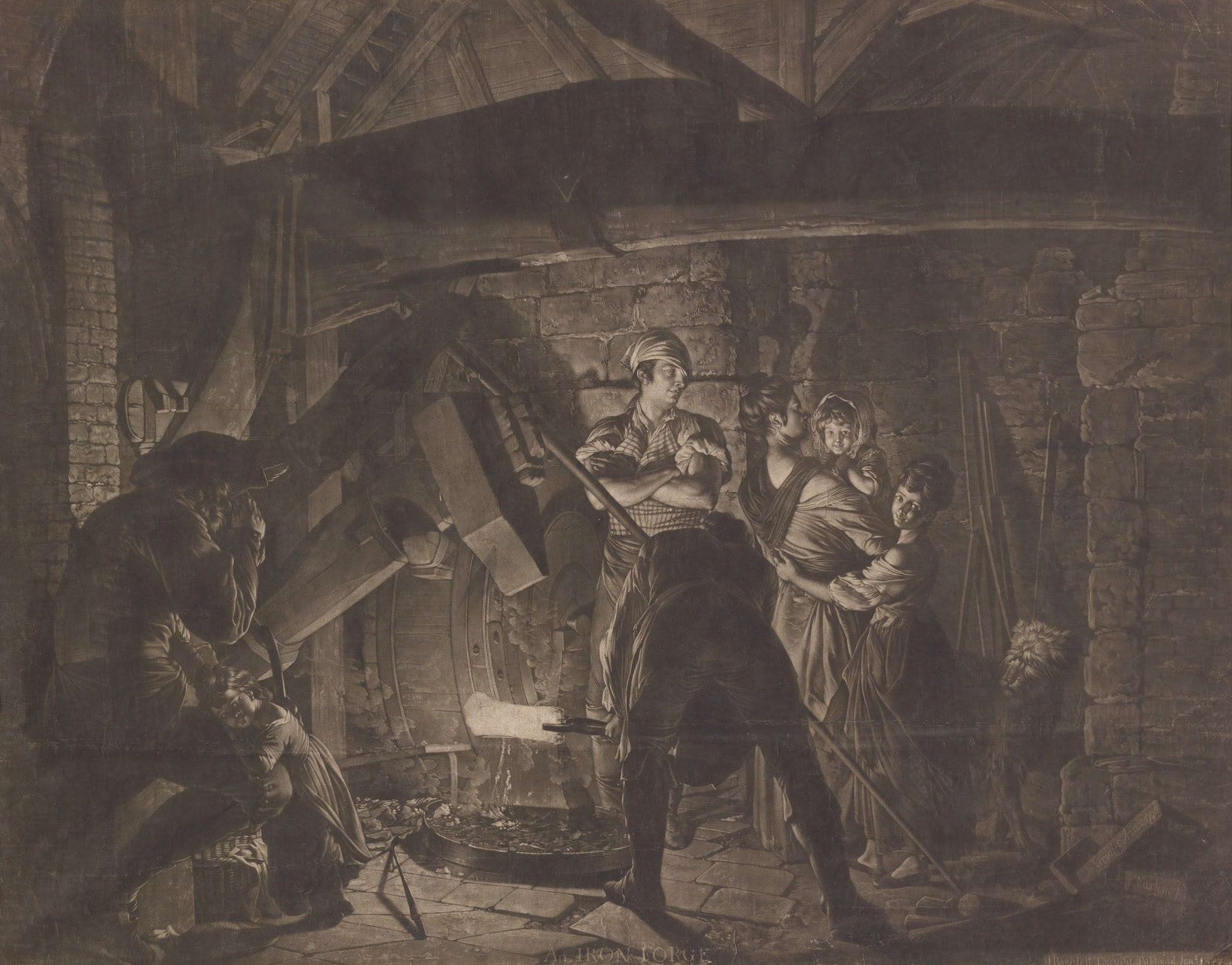
Richard Earlom after Joseph Wright of Derby, An Iron Forge, 1773. A water-powered forge; mezzotint published by John Boydell. Courtesy of Science History Institute.[84]
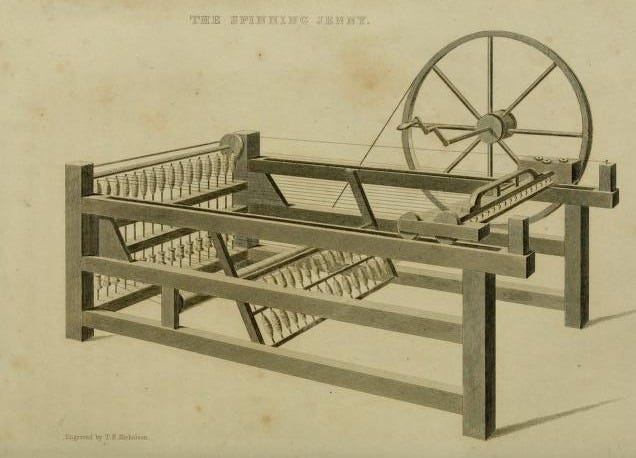
We begin in the 1760s, in the early years of the Industrial Revolution, as James Hargreaves’ spinning jenny started multiplying a spinner’s output.[1] This was a major technological breakthrough, although it was met with unease among skilled workers. Not only did hand spinners fear job loss, but they also faced the realization that the skill they had spent years developing was now available in abundance.
This unease was not abstract either. In 1768, hand spinners fearing unemployment broke into Hargreaves’ house and destroyed his machines, prompting him to relocate to Nottingham.[2] Beyond this attack on Hargreaves’ house, historical accounts of early British machine-breaking point to resistance around John Kay’s flying shuttle[3] and assaults on mills using Arkwright’s machinery in 1779.[4] Even before the Luddites, now synonymous with resistance to technological change, early seeds of social unrest started appearing in pockets of rapidly industrializing Britain.

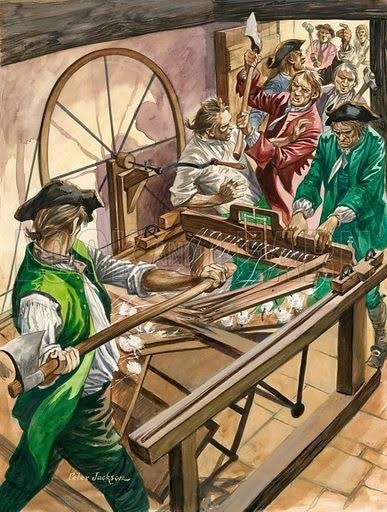
By 1786, these fears found their way into the Leeds woollen workers’ petition. The petition opposed the spread of scribbling machines, used to prepare wool for spinning, and was addressed to merchants and clothiers, asking them to discourage the use of such machines. The workers feared losing their livelihoods, the ability to pass on a trade to their kids, and any security from retraining because the next machine might replace the next trade as well. As the petitioners put it, “by the time we have served our second apprenticeship, another machine may arise, which may take away that business also”.[5]
One of the most famous expressions of unrest against rising automation during the Industrial Revolution would come in the 1810s with the emergence of the Luddites.
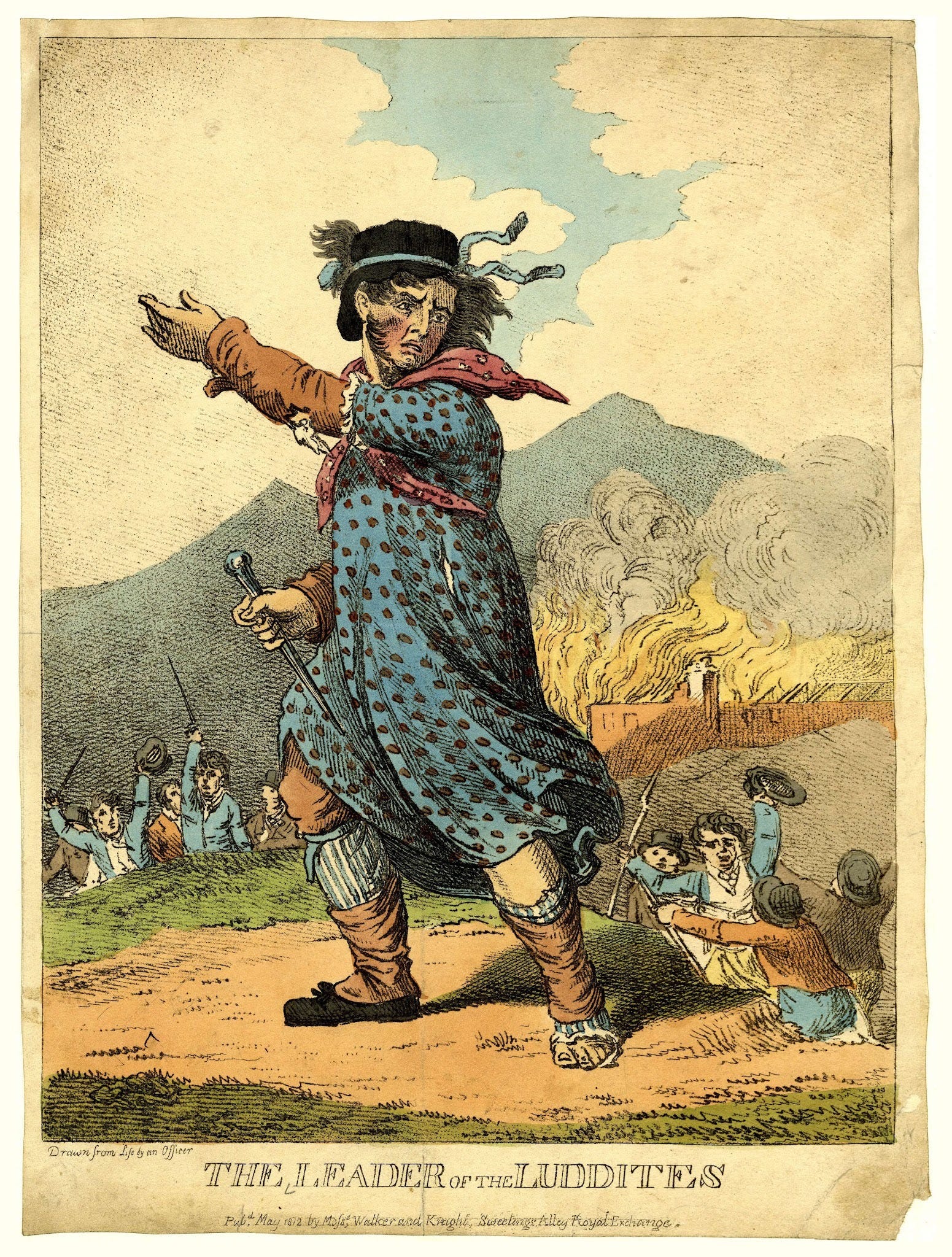
Although “luddite” is largely used today as a pejorative, the historical Luddites in England in the early 1810s were highly skilled workers. When automation started taking away their jobs, they protested to defend their wages, bargaining power, and craft standards.[6]
The Luddite movement began in the middle of the Napoleonic Wars (1803–1815) in Nottinghamshire in March 1811, and eventually spread to Yorkshire and Lancashire the following year. Participants included framework knitters, cloth dressers, and weavers. They protested not only wage cuts but also the undermining of craftsmanship by machine-led production practices.
Contrary to their popular image, the Luddites were quite adept at using machines, but they largely opposed how they were being used by employers.[7] Such practices were “to the discredit and utter ruin of our trade,” as the Declaration of the Framework Knitters put it on 1 January 1812, under the name of Ned Lud, a mythical figurehead for the movement.[8] They used various methods to get their voices heard, ranging from petitions and threatening letters to machine-breaking. High food prices and hardship exacerbated by the Napoleonic Wars added to the pressure, as trade restrictions disrupted markets and poor harvests worsened conditions.[7]

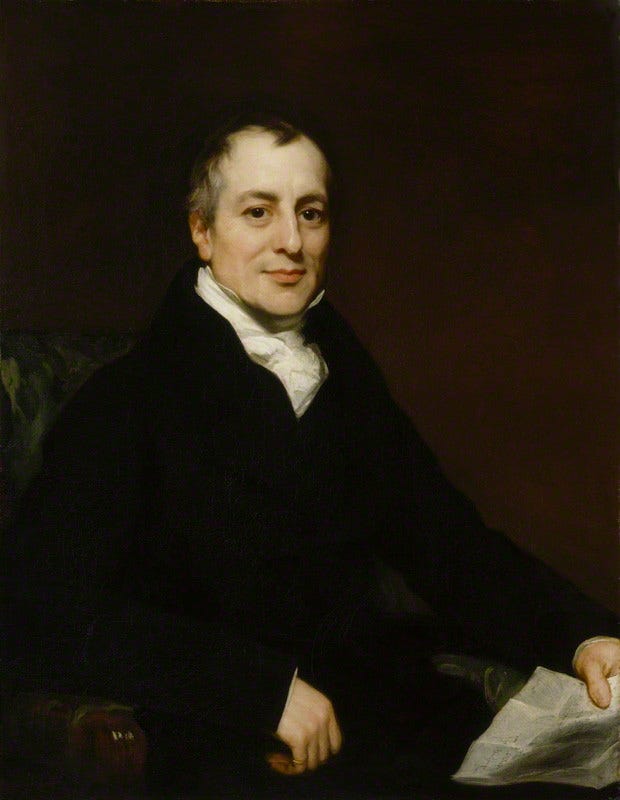
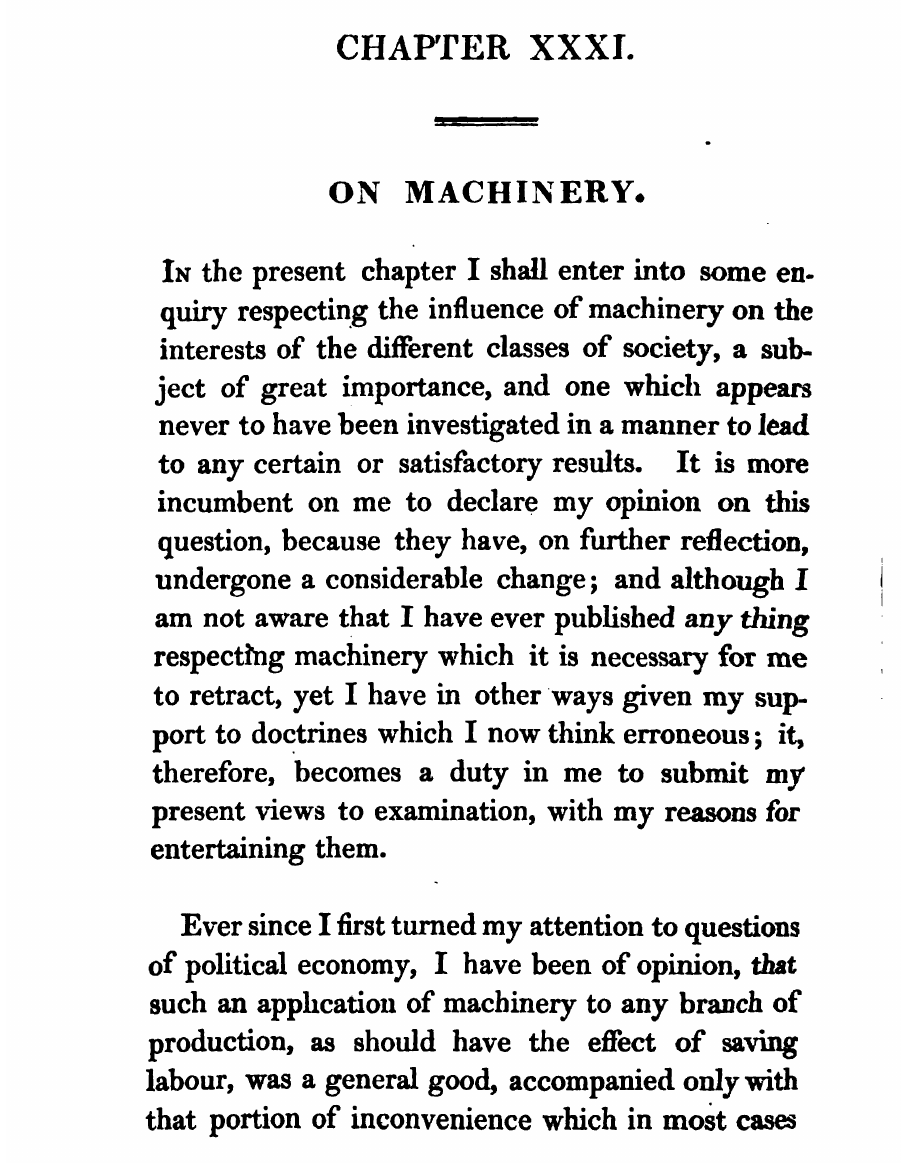
By 1821, economist David Ricardo had revised his opinion on the effect of technological change. While his initial view was that machinery would benefit all classes, he explained his change of view in “On Machinery,” saying his opinions had “undergone a considerable change” and arguing that while automation could increase the net income of a country, this could still come with large swathes of workers losing their employment and generally becoming worse off.[9]

The case of handloom weavers is particularly instructive for understanding Ricardo’s viewpoint. When spinning became mechanized, it initially increased demand for hand weaving. Weaving expertise was still needed, and hand weavers remained in demand as cheaper, more plentiful yarn could be produced “factory style.” But the spread of power looms in the 1820s and 1830s began to undermine that demand. The value of hand weavers’ skills and craft fell, leading to lost earnings and, in many cases, wretched poverty. As economic historian Robert C. Allen puts it, “The power loom, in turn, devalued the old skills, so poverty accompanied progress.”[10] The decline was gradual but persistent; it unfolded over decades, and while the weavers retained their skills, they could no longer sustain the same livelihood.
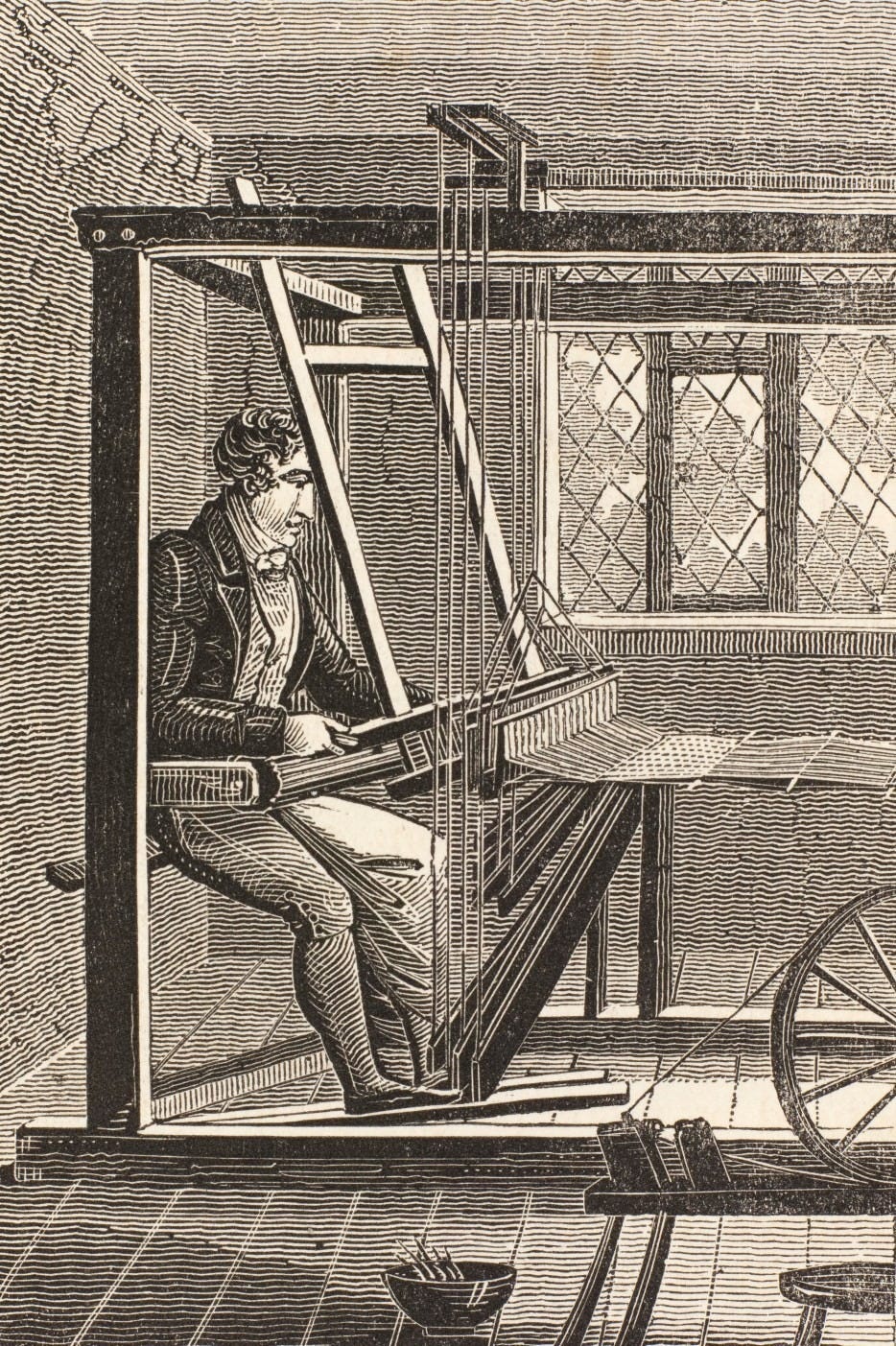
A handloom weaver at work, 1824. Science Museum Group Collection, reproduced by Global Threads.[62]
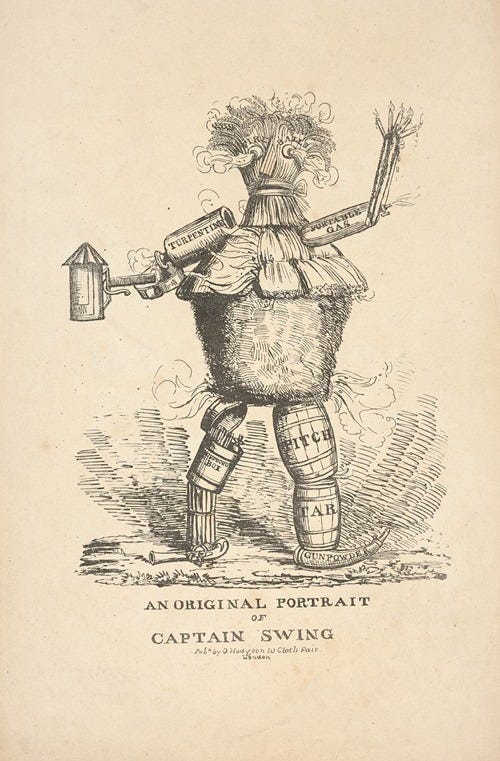
By 1830, fears around automation-led displacement spread to wider parts of Britain, with disturbances beginning in Kent that summer and gradually widening into southern and eastern England. The focal point for these disturbances was typically threshing machines that threatened an important source of autumn and winter employment: separating grain from stalks and husks. Coupled with already low wages, unemployment, and poor harvests in 1829 and 1830, the spread of such machines lit the match for widespread rural unrest.[11]
Protesters generally demanded higher wages and, in some cases, even the outright removal of threshing machines. As one anonymous letter to the Duke of Richmond put it, “all we want is Work & fair wages.”[12] Methods of protest ranged from machine-breaking and threatening letters to arson. Another letter warned that “Thou shalt hear further from me when Kings College is in flames.”[13] These riots came to be known as the “Captain Swing” riots. Captain Swing was an invented name used to conceal identities and intimidate recipients by invoking a mythical leader.[11]
Craft, Creativity, and Identity
The anxiety was not only about whether work would survive, but also about what would remain of the worker’s craft.
Losing work was not just about losing income. It was also about losing something within work itself. John Ruskin’s “The Nature of Gothic,” published in The Stones of Venice in 1853, criticized the division of labour amid expanding industrialization, arguing that it reduced workers to repetitive tasks instead of allowing them to have agency and exercise judgment and imagination.[14] Designer and social activist William Morris expanded on these concerns in his “Art and Labour” (1884), arguing that “the workman must once more be master of his material, tools, and time.”[15] Morris wanted people to make useful, beautiful objects and retain a sense of pride in their work.
Drawing on these ideas, the Arts and Crafts movement developed later in the nineteenth century to promote craftsmanship and less dehumanizing ways of making things. The Arts and Crafts Exhibition Society, founded in 1887, drew on Morris as a major influence. The goal of the movement was not simple-minded opposition to machines, but a broader concern with what losing agency over one’s work meant. The central concerns were how production was organized, whether and how design was separated from execution, and how the loss of creative satisfaction was being compensated.[16]
These concerns also extended to art and the role of human imagination.
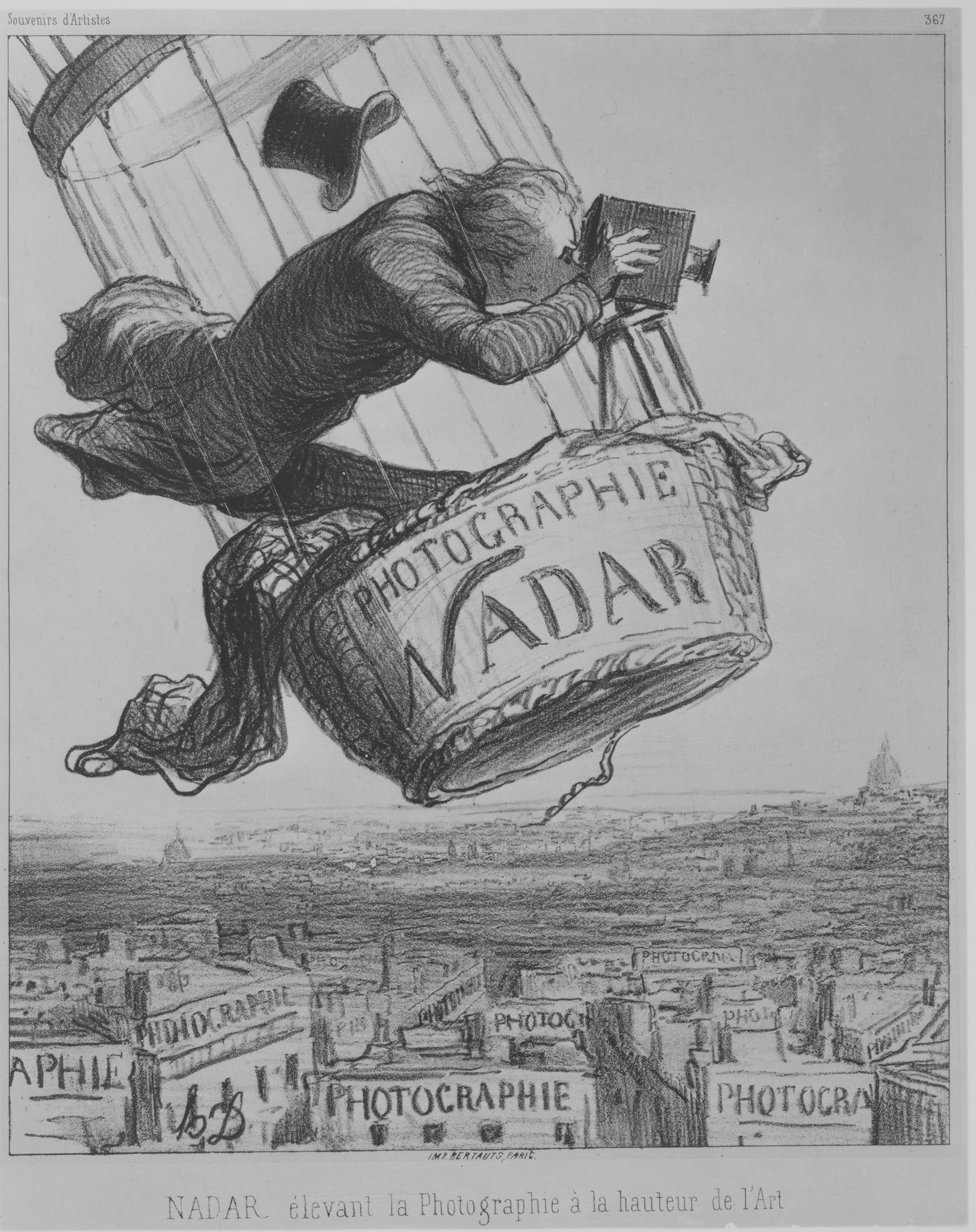
In 1859, French poet and art critic Charles Baudelaire attacked photography’s growing claims to artistic status in his Salon of 1859.[17] By the time of his writing, photography was already established, with Daguerre’s process publicly announced in 1839.[18] Baudelaire objected to conflating accurate reproduction with artistic achievement. The former was not genuine art, he would argue. But art, real art, required imagination. It was not about simply recording what everyone could see. Photography should remain “the servant of the sciences and the arts,” as he put it in the same essay.[17]
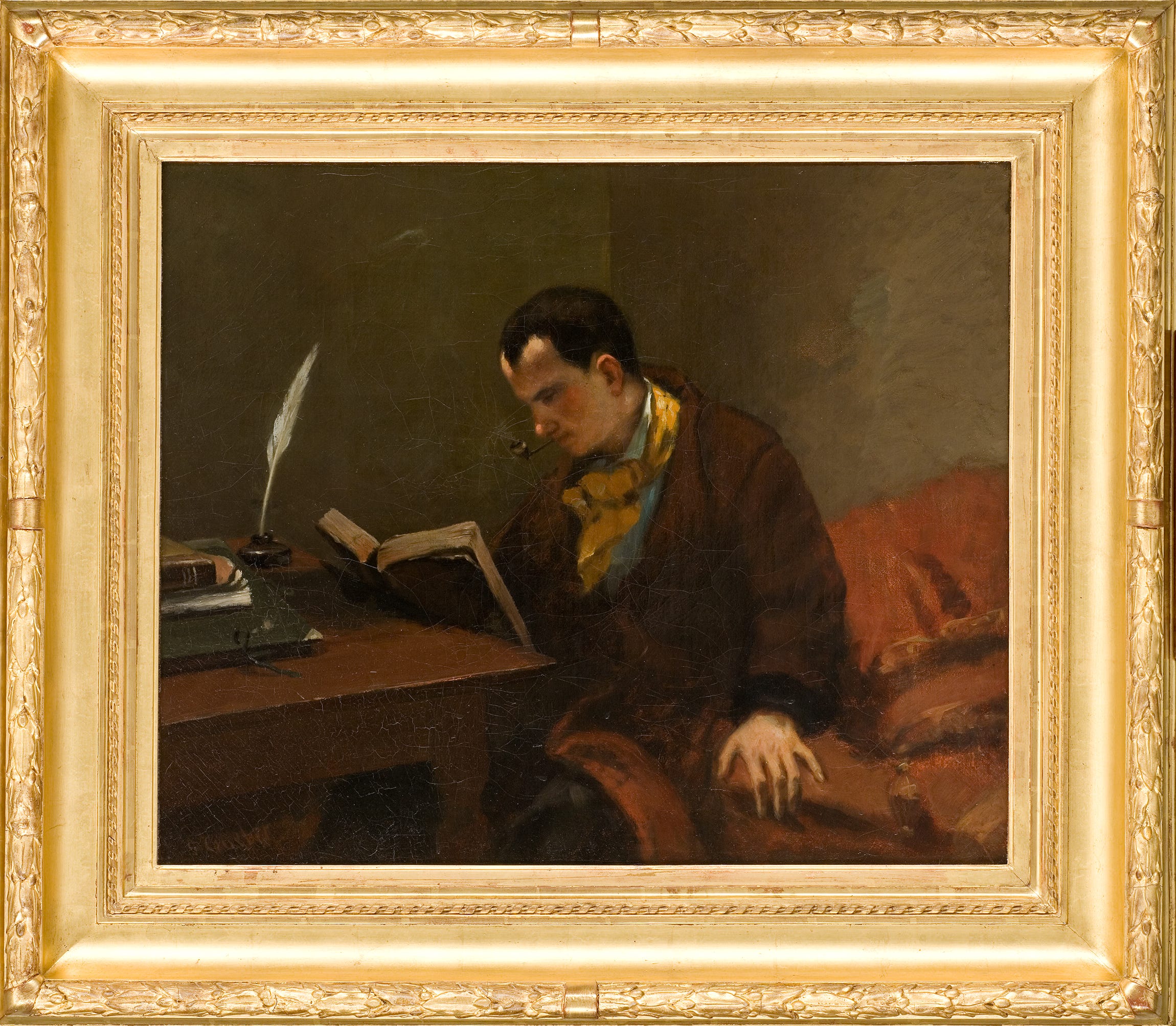
Gustave Courbet, Portrait of Charles Baudelaire, circa 1848. Oil on canvas. Musée Fabre, Montpellier. Image via Wikimedia Commons.

While Baudelaire accepted photography’s usefulness for science, documentation, and preservation, his primary objection was the encroachment of this relatively new technology on the imaginative (and, in his mind, pure) domain of art. Photography, in his view, had contaminated the artistic enterprise.[17]
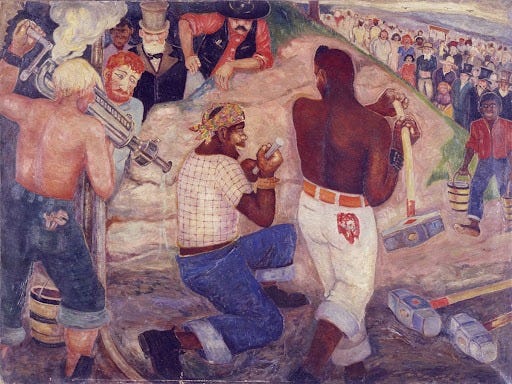
The fear of losing the meaning of work and one’s identity around it also found its way into folklore. In the American legend of John Henry (not the Red Sox and Liverpool owner!), a skilled worker stakes his life to show he can outperform a steam drill. This is man versus machine, quite literally. “I’ll die with my hammer in my hand,” John Henry declares in an early version of the ballad.[20] Steel drivers hammered bits into rock to make holes for explosives, typically with a partner working in tandem who held and repositioned the bits. In the legend, Henry challenges this steam drill and wins. But he pays with his life, dying from exertion. The legend is often associated with the construction of the Great Bend Tunnel in West Virginia in the early 1870s.[19] In this story, losing one’s work was about pride, identity, and all of those things; it wasn’t just about income and jobs. It was deeply personal.
Control over Work in the Machine Age
In the twentieth century, these concerns extended to how work was organized and how much control workers retained over it.
The early 20th century was marked by increasing loss of control over how work was done. The Principles of Scientific Management, published by Frederick Winslow Taylor in 1911, laid out management principles for the firm.[21] The goal of management was to study work activities, establish methods and timings, and give workers specific instructions on dos and don’ts. Planning increasingly became the responsibility of management and not of the individual worker. Gradually, workers lost discretion and the ability to exercise judgment over what constituted “good work.” As Orrin Cheney, a machinist at Watertown Arsenal, put it, “I could not follow this man’s instructions out and do my work and do it properly.”[22] Although Taylor presented his system as a win-win for both workers and employers through greater productivity and higher earnings, workers’ agency over work was gradually eroded, and they expressed frustration.
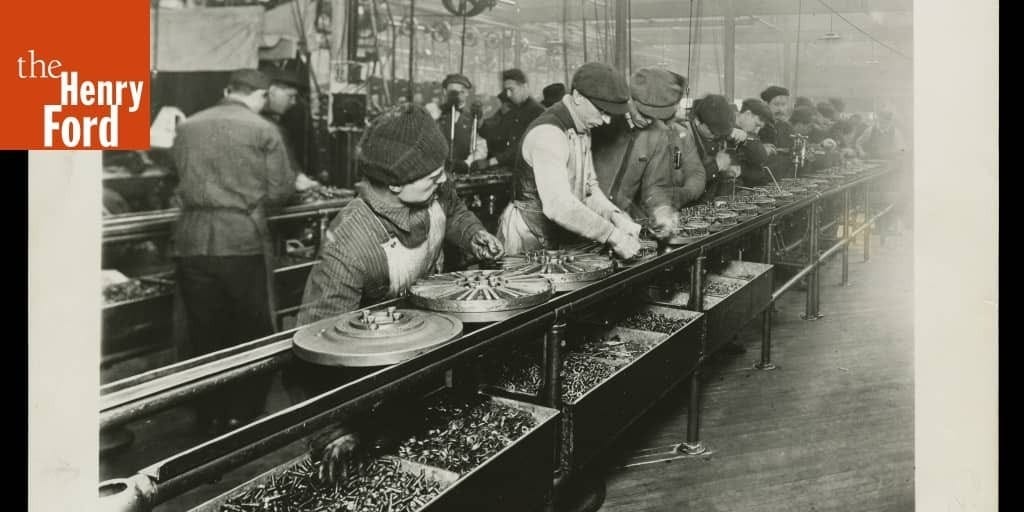
Magneto assembly line at Ford’s Highland Park plant, April 1913. The Henry Ford collection.[66]
In 1913, Henry Ford introduced moving assembly-line methods at Highland Park, slowly refining them through 1914.[23] Work became divided into small, repeated parts, and the moving line determined the rhythm. Workers in the factory lost control of the pace of work as well as the satisfaction of contributing a broader range of skills, instead focusing on what they were “told to do.” One unnamed Ford worker captured the frustration of repeatedly installing the same numbered nut: “I will be Nut No. 86 in the Pontiac bughouse.”[24] Many also disliked the work and left, with turnover becoming a serious problem. To counteract this, Ford introduced the five-dollar day and an eight-hour working day to compensate for demanding but repetitive work.[23][24]
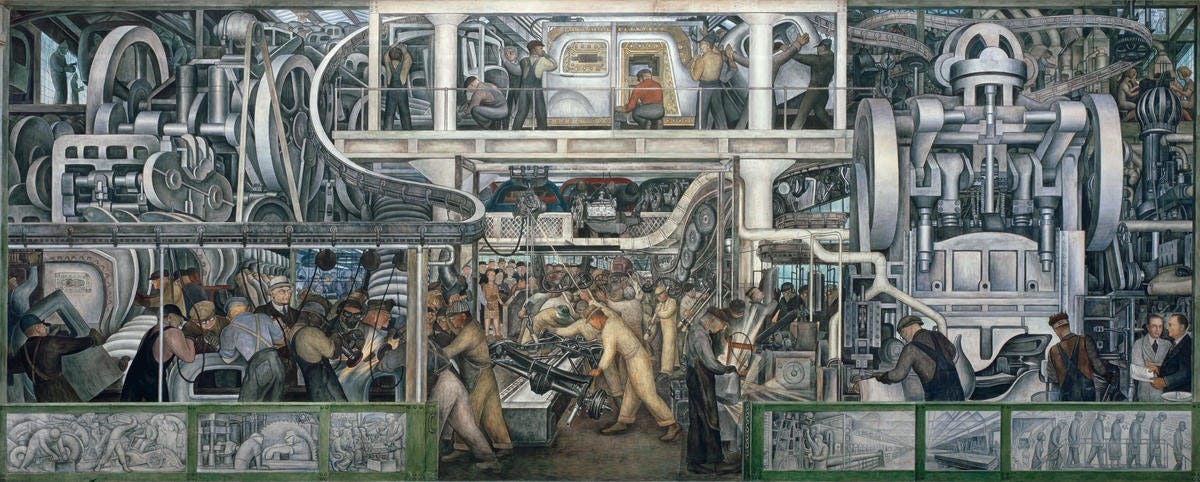
These changes also found their way onto the big screen.
The issue wasn’t always work and its reallocation. It was often about what work became. Increasingly machine-driven, it shrank the space for human judgment and creativity. Charlie Chaplin’s Modern Times (1936) gives a visual expression of man becoming machine, not just trying to live with it. In Chaplin’s factory, the worker repeatedly tightens bolts on an assembly line. Soon the pace overwhelms him, and he suffers a nervous breakdown.[30]
Well, it gets worse. Enter the automatic feeding machine! It is tested on the human to reduce time spent eating. Management wants to control lunch hours. In the famous machinery sequence, the worker’s body passes through huge gears. The man is not with the machine, but he is one. As Chaplin described it, “the way life is being standardized and channelized, and men turned into machines.”[31] Meanwhile, management monitors him through a screen (including on a toilet break), with control expanding beyond whether work was done to the micromanagement corporate hell of how time was spent.[32]
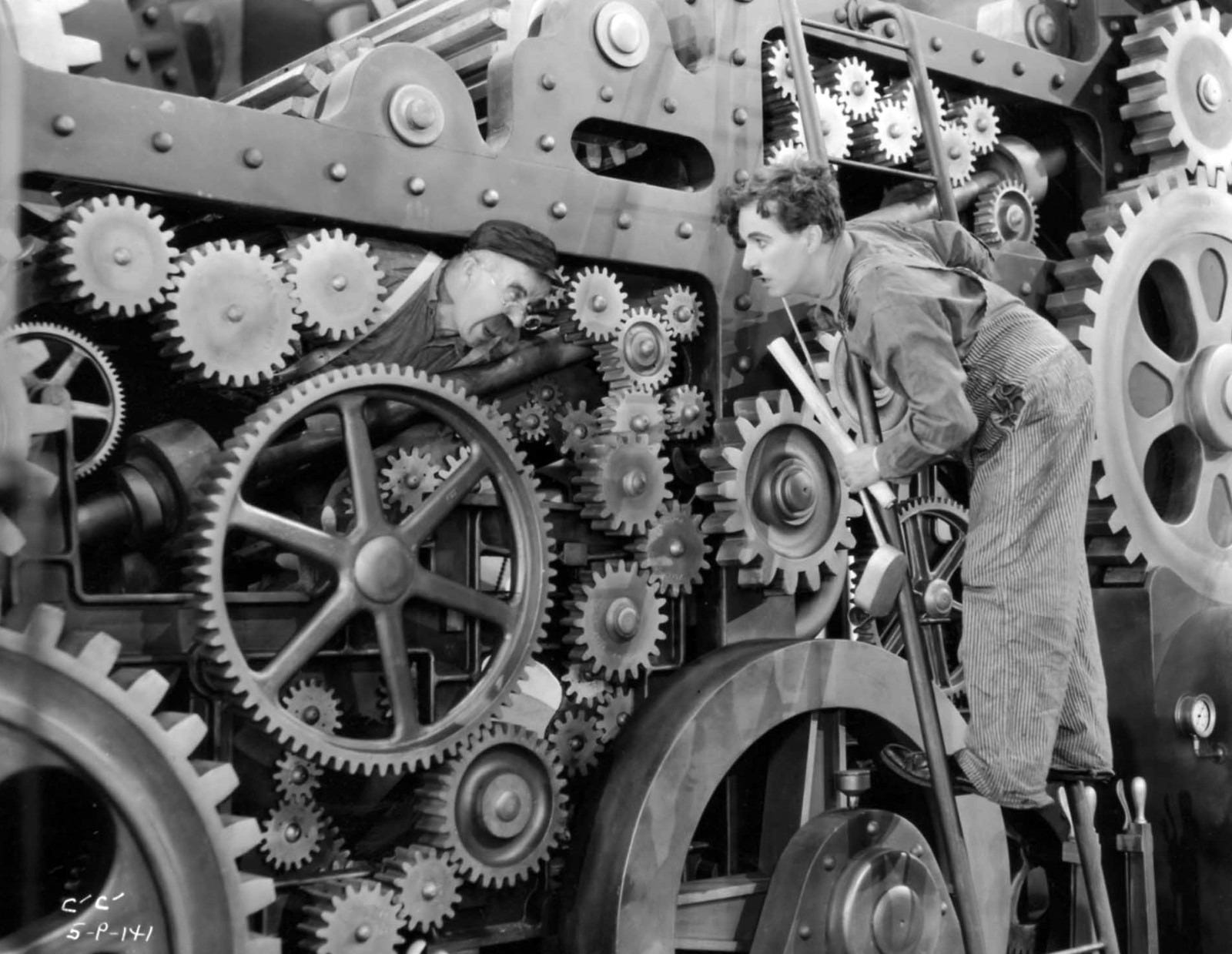
Charlie Chaplin in Modern Times (1936), film still. Reproduced by Festival Entrevues Belfort.[54]
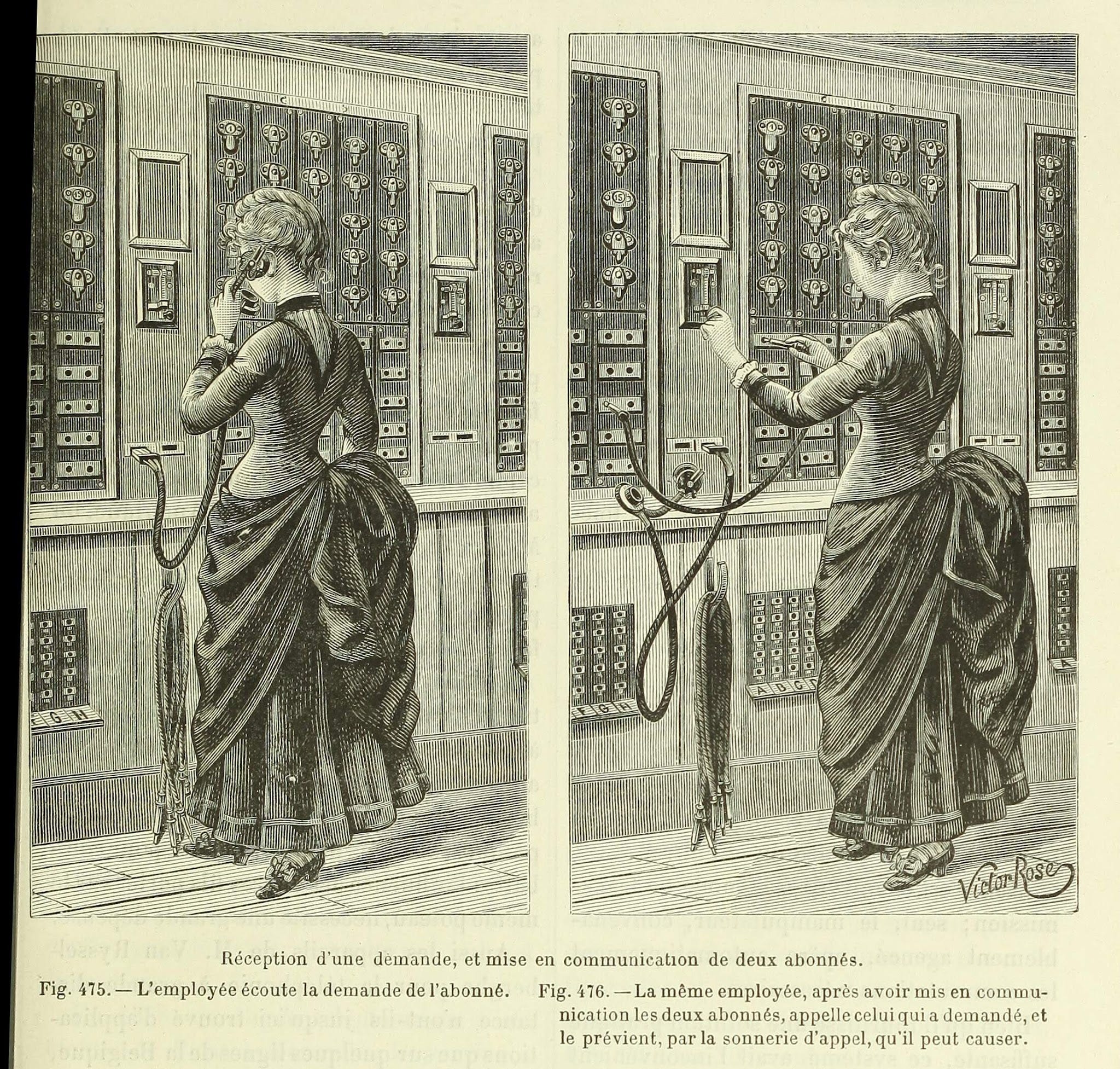
Back in the real world, jobs kept changing or being lost, without necessarily making the people who lost them whole. Take telephone operation. This was a major occupation for young American women. Operators were in charge of manually connecting calls at switchboards. The work required speed, coordination, and teamwork. This was a skilled role. As mechanical dialing spread, there wasn’t as much of a need for manual operators anymore. Between 1920 and 1940, AT&T offboarded (pun intended) manual switches, mechanizing exchanges serving more than half of the U.S. telephone network.[26]
Manual operators gradually disappeared, with younger generations still finding work. Nevertheless, the losses for existing operators were often persistent, and they were commonly relegated to much lower-paying jobs. The employment of subsequent cohorts held up as other clerical and service jobs expanded. But existing operators, despite all their skill and dexterity, were more likely a decade later to be in lower-paying occupations or no longer working.[26]
Other kinds of skilled work faced similar pressures.
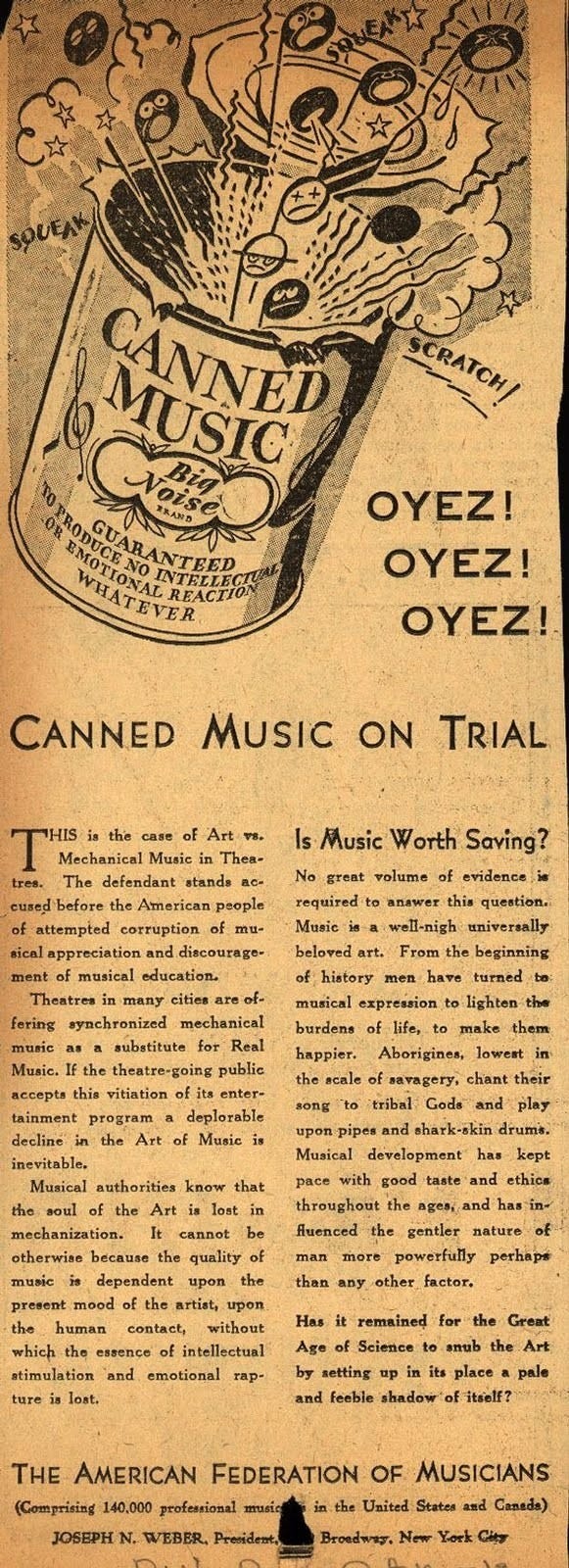
Sound films began displacing cinema musicians in the late 1920s. Films now used recorded soundtracks, replacing live orchestras and organists. Per estimates of the American Federation of Musicians (AFM), around 20,000 theatre musicians lost their jobs during this (fairly quick) transition.[27]
These recordings also changed the economics of performance. You could record it once and play it at your pleasure. The exclusivity of seeing a performer and experiencing his creation could now be replaced by a recording sold in a (juke)box. This isn’t to say recordings didn’t create new opportunities, but they also often didn’t reach musicians losing local work.[27]
To highlight their growing worries, musicians campaigned against “canned music,” with the AFM forming the Music Defense League in 1930. Its campaign defended live performance as an art with an essential human element. As the union’s journal, International Musician, put it in February 1930, “Music is an emotional art and the human element is essential to its enjoyment.”[28] The dispute eventually broadened to compensation, with the AFM’s two-year recording ban from 1942–1944 pressuring record labels to contribute money toward the livelihoods and employment of live musicians.[27]
Automation was also changing another familiar job: operating an elevator.
Back in the 1950s, elevator operation was skilled work.[33] Operators controlled speed and direction and had to manually stop the car level with the correct floor. Judgment and timing were both key.[33] In 1950, Otis installed its first operatorless Autotronic system at the Atlantic Refining Building in Dallas.[34] This was a milestone: not only was the elevator operatorless, it was also fast.
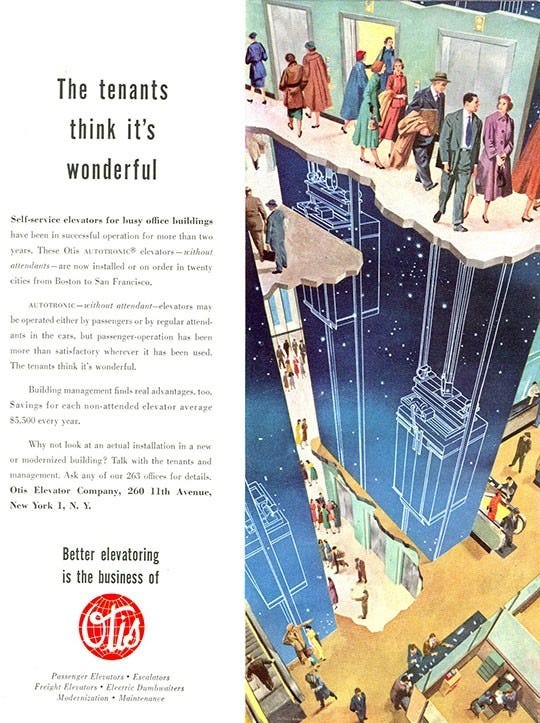
Otis Autotronic elevator advertisement, 1952. Otis historical collection.[55]
The manual operator role faded gradually, and although operators remained common in the early 1950s, automatic elevators displaced what was once skilled work. Decades later, one of the remaining operators, Margaret DeBold, captured the agency the role could offer: “This is my little world and I have control of it,” she told the Los Angeles Times in 1990.[35]
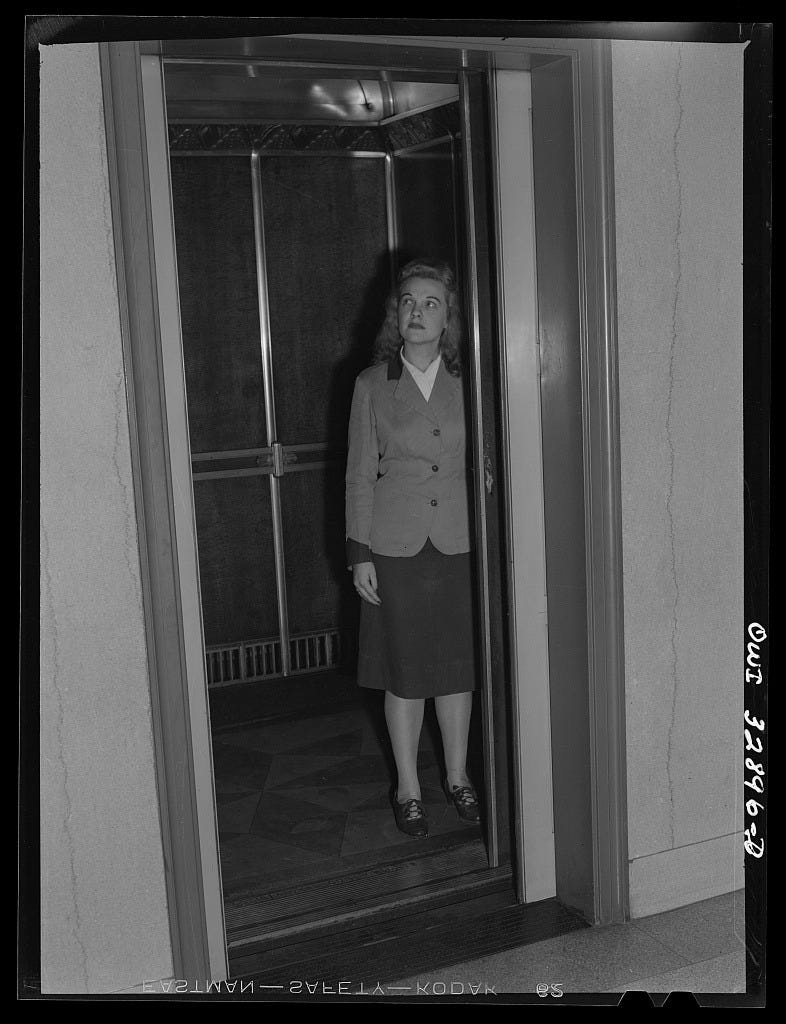
Jack Delano, Dorothy Eyster, an elevator operator in a downtown Philadelphia office building, June 1943. Library of Congress, FSA/OWI Collection.[83]
As automation became part of everyday life in the twentieth century, writers and thinkers continued exploring what a world with less work might mean for people. For example, the growing despair around the loss of work’s meaning amid the rise of machines found its way into Karel Čapek’s R.U.R. in 1920. In the play, artificial workers[96] promised to free humans from the toil of work, ushering in an era of abundance (sound familiar?). But things weren’t so rosy in the world of the play. If work disappears, what happens to the purpose and meaning that people attach to it? As Alquist, a builder, puts it, “There was some kind of virtue in toil and weariness.” Well, the play’s answer was for the robots to revolt and nearly wipe out humanity. Who needs these whiny humans? Good vibes only.[25]
The question also occupied economists.
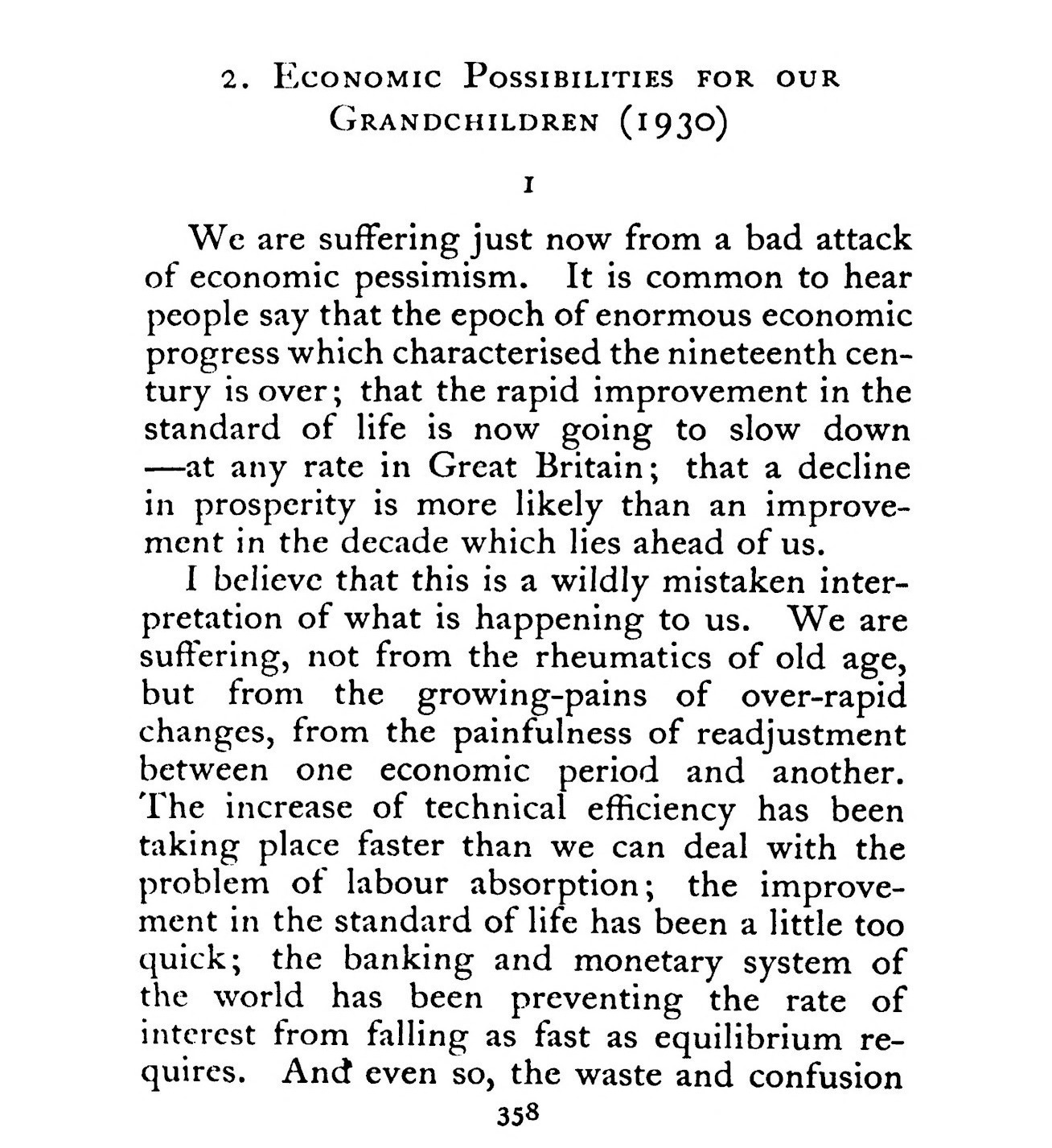
Around the time of these developments in music and switchboards, Keynes wrote Economic Possibilities for Our Grandchildren (1930), looking beyond the immediate crisis and imagining life a hundred years ahead. He defined technological unemployment as labo(u)r-saving innovation advancing much faster than society’s capacity to find new work for displaced workers, although he viewed such unemployment as transitory. Over the longer term (if we weren’t already dead, of course), he thought productivity and capital accumulation could basically solve the struggle to meet basic material needs in advanced economies.

Duncan Grant, Portrait of John Maynard Keynes, 1917–1918. Oil on canvas. Charleston. © Estate of Duncan Grant / DACS. Image via Art Fund.
He imagined three-hour shifts, partly because he thought people would still feel a need to work, so accustomed were they to a life organized around it. In other words, even with material abundance, questions of purpose would leave people wanting some work to do. Like Čapek, he imagined liberation from toil through machines, but also questioned whether people would really know what to do with it—“how to use his freedom from pressing economic cares”—although he was more hopeful in his tone and didn’t resort to killing off humanity![29]
Fiction kept returning to the same question of human coexistence amid the rise of machines.
In 1952, Vonnegut’s Player Piano imagined a world where machines did most of the work and people were provided for. Unlike Chaplin’s world, where the man was the machine, in Vonnegut’s the man was largely freed from working with it. Vonnegut imagined an extensively automated America, with engineers and managers running the system and people who were good to have around (they weren’t killed off, unlike in R.U.R.) but not strictly “needed.” The novel follows the protagonist, a successful engineer who becomes increasingly troubled by the society he is “managing” and eventually rebels against the automated order.[36] Unlike Keynes’s more hopeful meditation on a world of technological progress, Vonnegut’s answer was darker. Removing the need for work did not automatically provide people with a sense of belonging or identity. As his protagonist, Paul Proteus, puts it, what people had lost was “the feeling of being needed and useful, the foundation of self-respect.”[37]
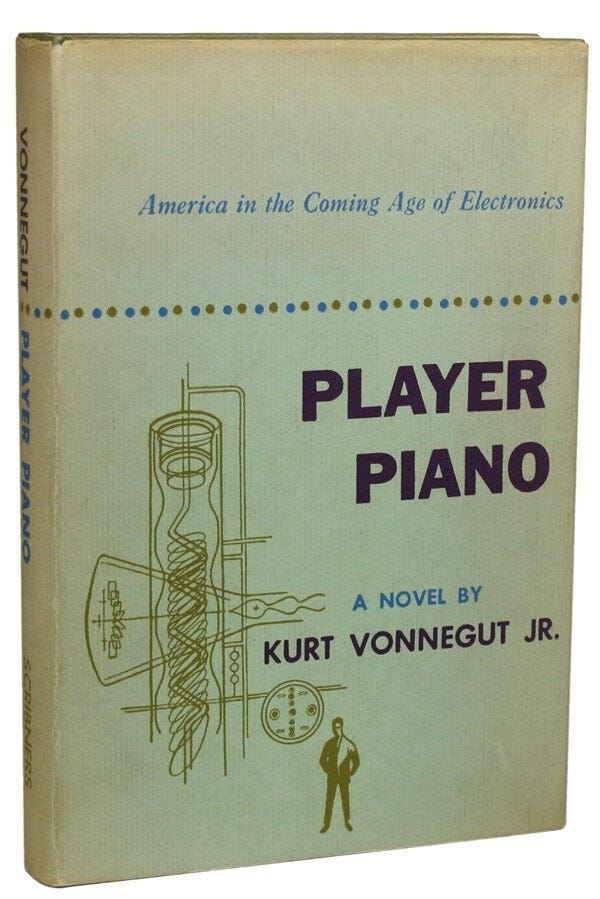
Player Piano (1952), first-edition dust jacket. Photograph reproduced by L. W. Currey.[68]
Against the backdrop of Cold War anxieties about humanity’s survival, automation raised questions about how people would live.
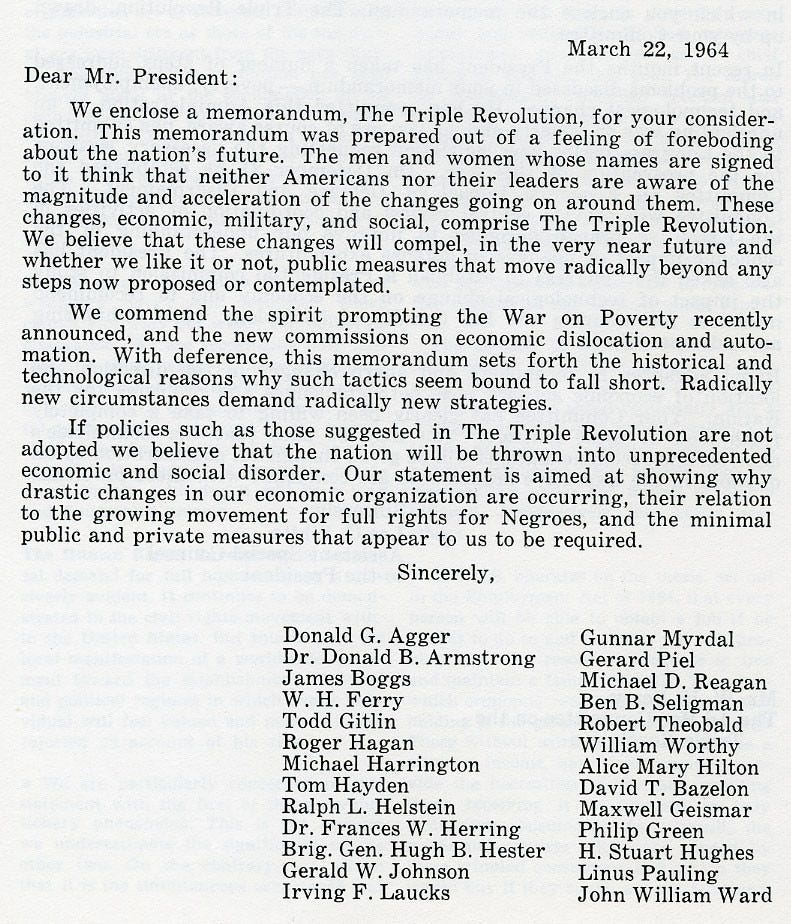
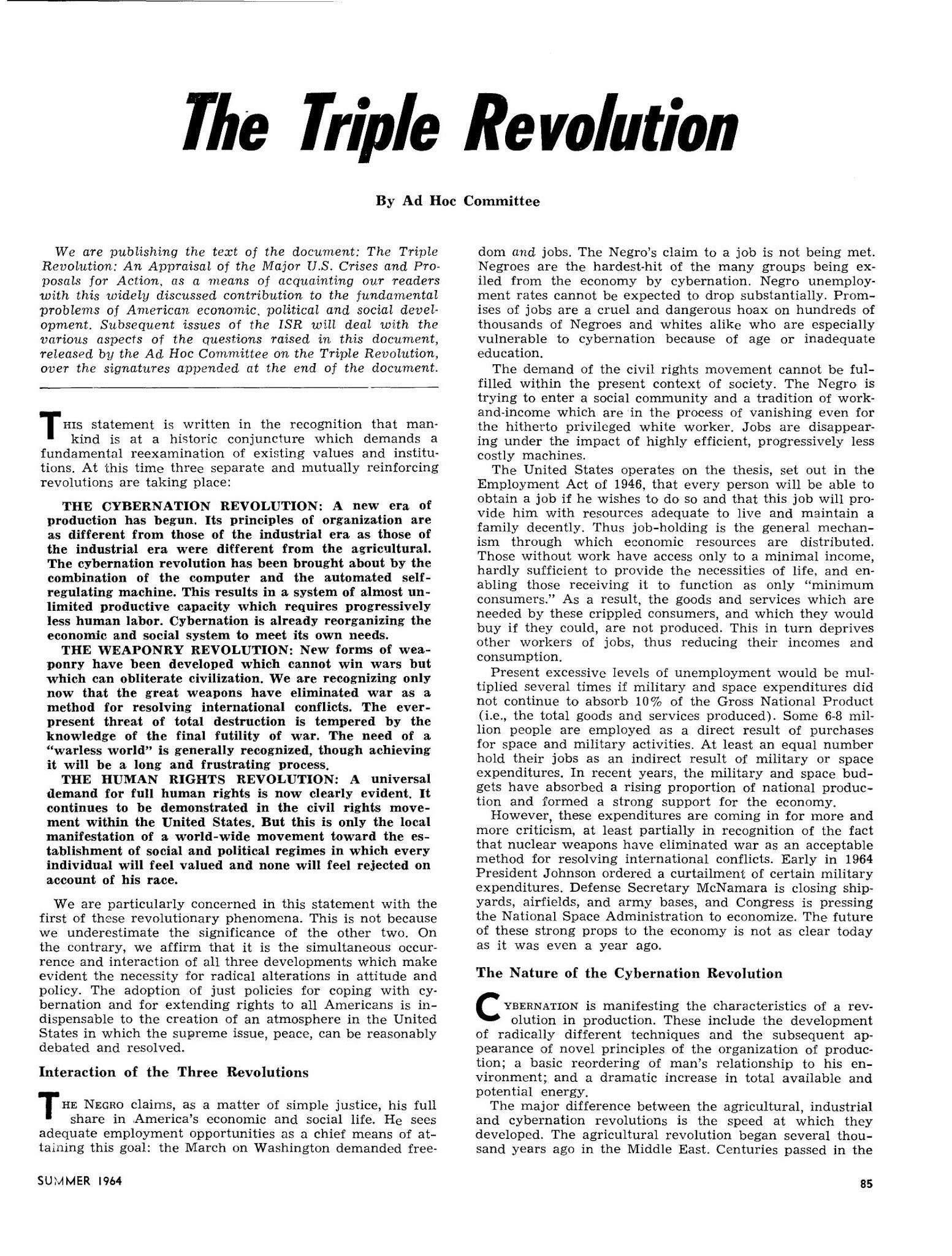
In 1964, 35 intellectuals and social activists sent a memorandum to President Lyndon B. Johnson. It raised the alarm that the traditional link between work and income was breaking, the rise of increasingly capable machines was upon us, and people still needed meaning and purpose to sustain themselves. The three revolutions were cybernation, nuclear weaponry, and human rights. The memorandum described cybernation as follows:[38][39]
“THE CYBERNATION REVOLUTION: A new era of production has begun. Its principles of organization are as different from those of the industrial era as those of the industrial era were different from the agricultural. The cybernation revolution has been brought about by the combination of the computer and the automated self-regulating machine. This results in a system of almost unlimited productive capacity which requires progressively less human labor. Cybernation is already reorganizing the economic and social system to meet its own needs.”[38]
The signatories weren’t fringe folks either. They included Linus Pauling (a Nobel laureate in both chemistry and peace), Bayard Rustin (a principal organizer of the 1963 March on Washington), and autoworker and writer James Boggs.[39][40][41] The group proposed a guaranteed adequate income as a right, alongside education, public investment, and retraining support. But it was not just financial support that they sought. They wanted opportunities for meaningful activity.[38]
In 1988, Shoshana Zuboff published In the Age of the Smart Machine and showed how, in the age of computers, humans could still keep their jobs but nevertheless give up a lot of control and agency over their work. She drew on multiyear studies of workplaces moving toward computer-mediated work, including factories and offices, showing that computerization changed what counted as expertise. Workers now encountered production through screens and textual information rather than getting their hands dirty in the factory. Tacit knowledge built around handling materials and interpreting the production process became less central, giving way to interpreting computer-generated information about that same process.[42]
Zuboff also distinguished between automating and “informating.” While computers could replace human activity, they also generated information that people could use to deepen their understanding. This created a new opportunity for knowledge and skill development, and how the organization integrated machines to hone workers’ understanding and discretion became a critical axis for coexistence between man and machine.[42] So even though parts of the production process became easier and opened up possibilities for new forms of mastery, workers could still feel that someone else was holding more and more of the reins. As one interviewee told Zuboff, “It is like you are riding a big, powerful horse, but someone is sitting behind you on the saddle holding the reins.”[43]
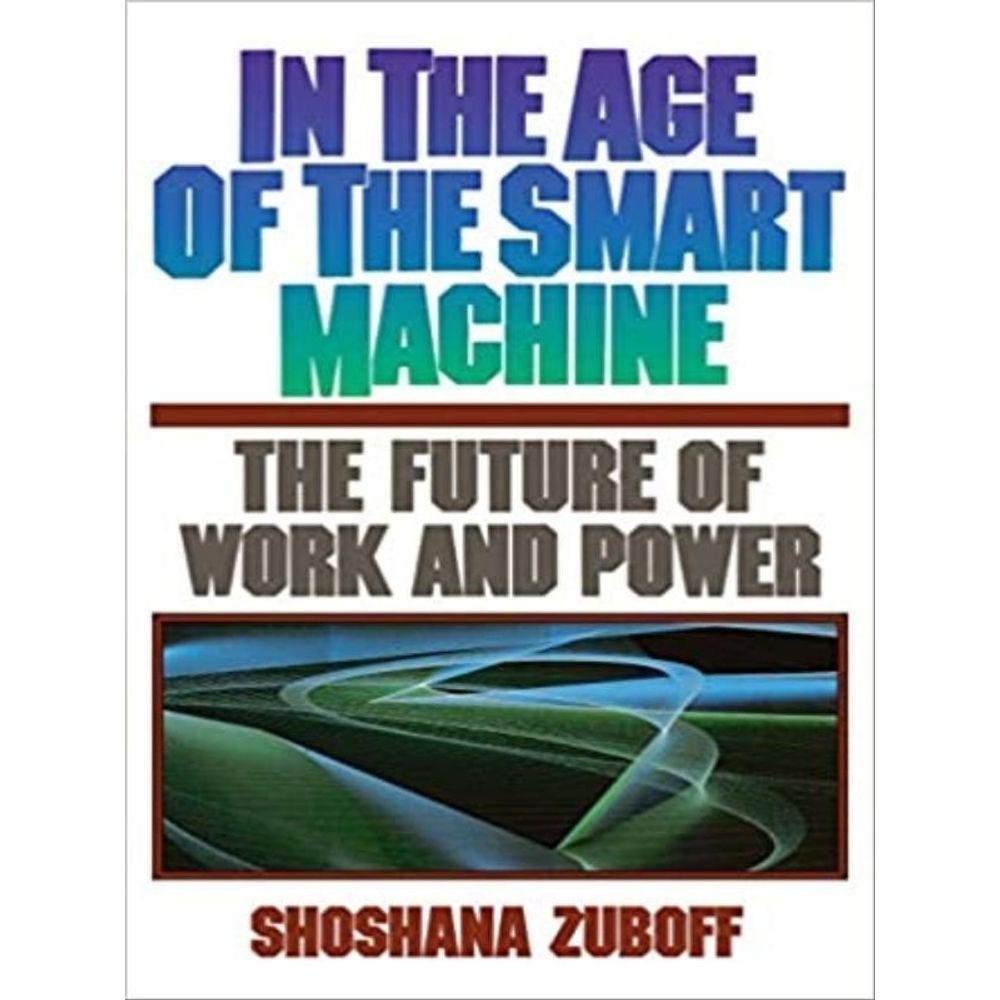
In the Age of the Smart Machine (1988), book cover. Reproduced by Martins Fontes Paulista.[69]
In 1995, Jeremy Rifkin published The End of Work, revisiting the cybernation theme. Computers, robotics, and telecommunications, he argued, would reduce demand for workers across industries. He feared this would divide society, with a small elite group managing the technological economy alongside displaced workers who had little say in this new world.[44] He proposed going beyond mere income support, echoing the Triple Revolution memorandum. He wanted an expanded “third sector,” basically nonprofits and community organizations, where people could do socially useful work supported by a “social wage.” This included skilled workers whose labour was devalued (or no longer valued) in the marketplace, but who still needed a community for purpose and meaning. As he put it, the aim was “Restoring hope and rebuilding the social economy.”[45]
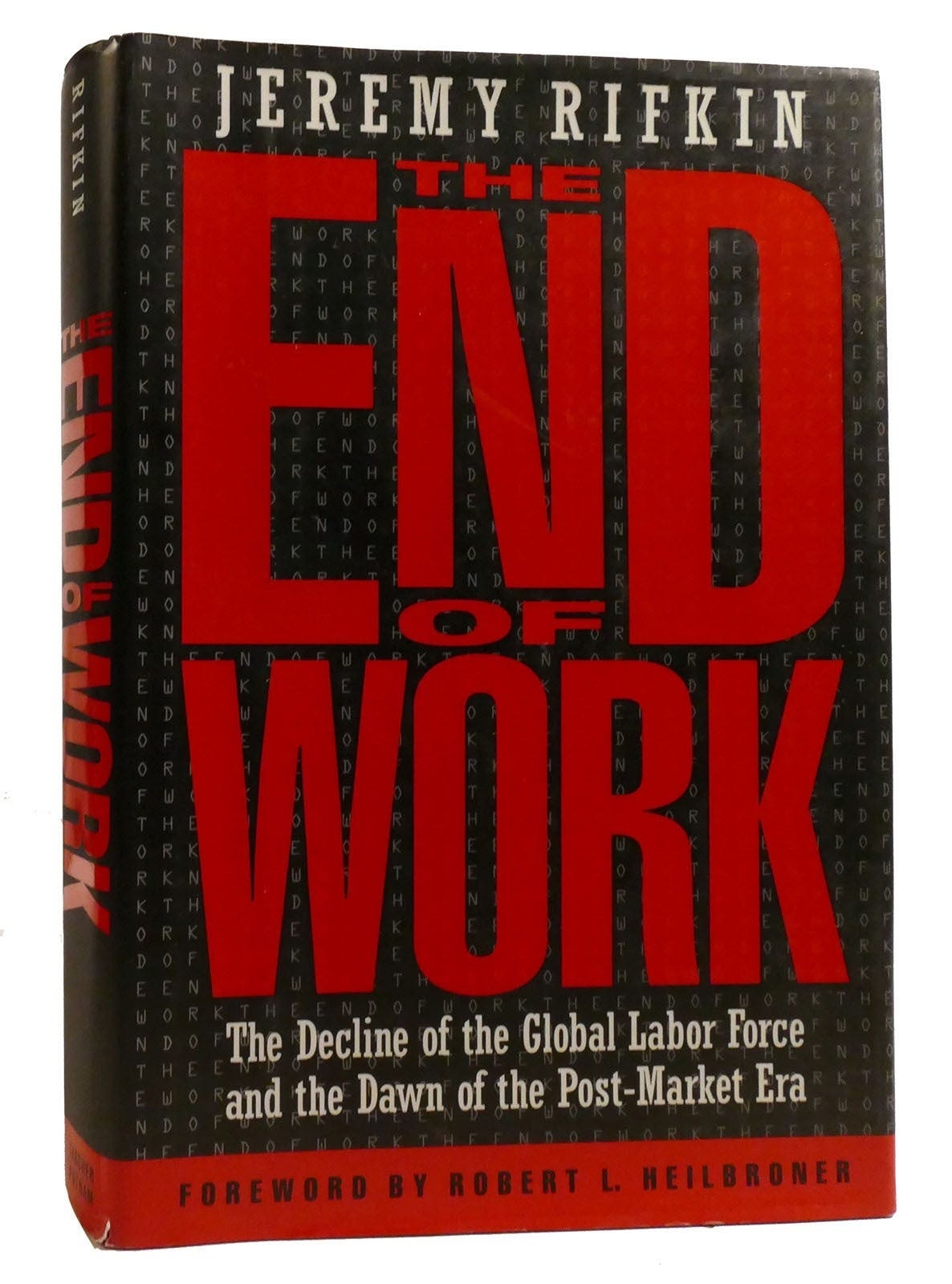
The End of Work (1995), first-edition dust jacket. Photograph reproduced by Rare Book Cellar.[65]
Machines had automated quite a lot of human work. Yes, they could sew clothes, operate elevators, and even record music. But surely the pinnacle of human intellect was out of reach?
This time, the human facing the machine wasn’t the fabled John Henry. It was Garry Kasparov, a grandmaster, former chess prodigy, and reigning world champion. Physical work was one thing, but chess involved mastery of opening positions, the middlegame, and the infamous endgame. The possibilities were too numerous to calculate exhaustively. It was a game of intuition, “feel,” and a touch of genius. Kasparov was confident. As he told Wired in 1995, “In serious, classical chess, computers do not have a chance in this century. I will personally take any challenge.”[46]
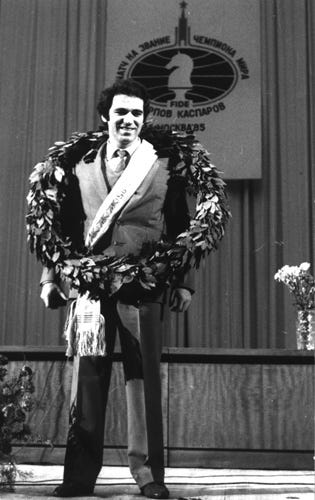
Garry Kasparov upon winning the World Chess Championship, 1985. S.M.S.I., Inc. / Owen Williams, The Kasparov Agency, via Wikimedia Commons. CC BY-SA 3.0.

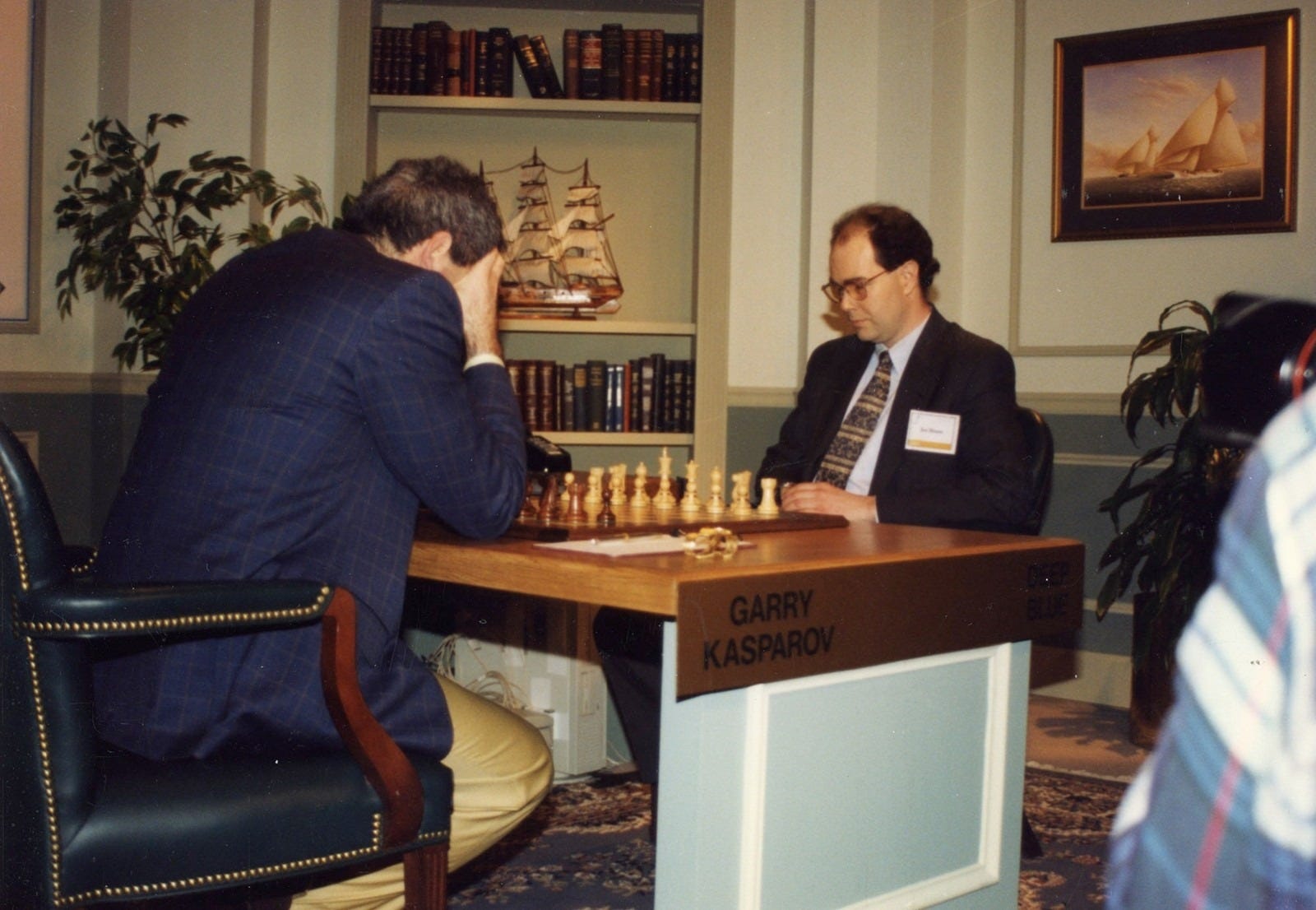
Deep Blue shocked the world by winning the first game of their 1996 match. However, Kasparov bounced back by winning the next one, then winning two more and drawing two to seal the series 4–2. The grandmaster had beaten IBM’s challenge. Kasparov was on track to not get beaten that century.[47]
That lasted a year.
The 1997 Deep Blue was faster, better, and stronger. It ended up beating Kasparov 3½–2½, becoming the first computer to defeat a reigning world chess champion in a match under standard tournament time controls.[47] Analyzing around 200 million positions per second, Deep Blue ran on an IBM supercomputer with 480 custom chess chips.[48]
Kasparov would later go on to embrace collaboration between humans and computers. He even introduced “advanced chess,” a chess format where players worked with computers as chess partners.[49] As he put it in 2022, “They are our tools, not our competition.”[49]
Machines and Intellectual Work
As machines entered offices and intellectual work, these questions took on new forms.
At the turn of the millennium, the Y2K episode epitomized the anxiety about computers centred on whether they could simply stop working.[72] Later in the decade, in 2009, students at Northwestern’s journalism and engineering schools developed the first version of StatsMonkey, working alongside professors including Rich Gordon and Kris Hammond. StatsMonkey was an early experiment in automated sportswriting, bringing into question how much of the journalist’s craft could be fully reproduced by software alone.[73]
StatsMonkey used baseball box scores and play-by-play data to identify key moments, select a storyline (e.g., a comeback or a pitchers’ duel), and generate a headline and recap. It could also incorporate a player’s stats for context.[73] By 2010, Narrative Science, the company that emerged from this initial collaboration, was generating college-football previews, in-game updates, and more.[74] While a much wider range of games could now be covered thanks to automation, critics questioned what would be lost without a reporter’s presence, observations, and feel for the game. Rick Green of the Hartford Courant asked about the loss of a reporter “talking to players, paying attention to what’s not said and feeling the mood.”[73] As in centuries past, the new millennium grappled with the central question of what happens to a professional’s identity when something that was previously an “art” suddenly becomes something a machine could produce.
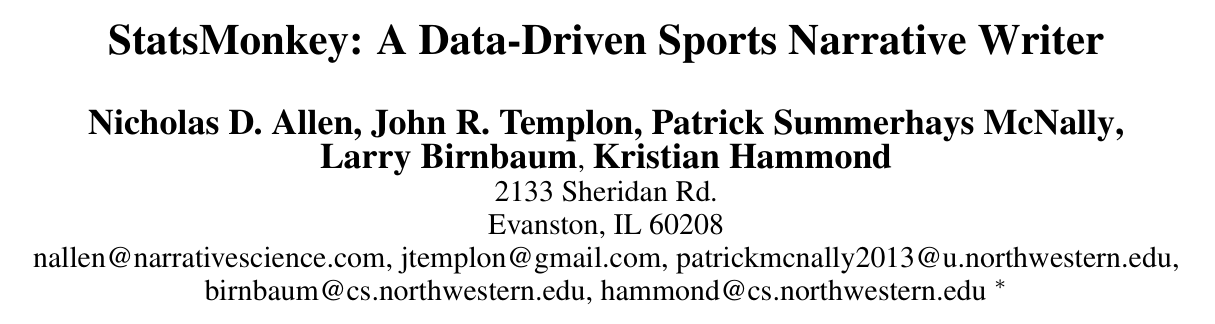
Title and author block from the original StatsMonkey paper, published in the AAAI Fall Symposium proceedings (2010). © Association for the Advancement of Artificial Intelligence.[75]
If chess had fallen to machines, Go was still considered a far greater challenge. In 2016, however, Go had its reckoning.
In 2016, DeepMind’s AlphaGo took on Lee Sedol, winner of 18 world titles. Its move 37 in game two became a symbol of out-of-the-box thinking, a kind of original insight that happens once in a blue moon. Lee would counter in game four with his own move 78, a striking human response, but he would lose the series 4–1. As Lee said of AlphaGo’s play, “But when I saw this move, I changed my mind. Surely, AlphaGo is creative.”[76]
Go generally has more possibilities than chess. DeepMind’s research paper estimated that while chess has approximately 35 legal moves per position, Go has around 250.[77] Searching the possibilities was harder. Moreover, Go’s territorial patterns made evaluating positions harder than using material counts as a starting point in chess. AlphaGo combined neural networks trained on expert games and self-play with search. Move 37-type moves were better suited to this new architecture.[77]
Lee Sedol had won 18 world titles, and yet even being one of the best humans ever to play the game could mean not quite reaching the summit of his craft. Reflecting on his retirement in 2019, he said, “Even if I become the number one, there is an entity that cannot be defeated.”[78] As with chess, the technology opened up new possibilities for learning, but it was clear that ingenuity, creativity, and “feel” for the game were no longer exclusively human territory.

Lee Sedol during his match against AlphaGo, March 2016. Photograph reproduced by Google DeepMind.[79]
Beyond games, the question of what remained distinctly human was becoming a dispute over creative work itself.
In 2023, Hollywood writers went on strike over control of creative work and who gets recognized as its author, among other issues. The strike lasted 148 days, beginning May 2 and ending September 27. While AI was an issue, it was alongside compensation, streaming, and staffing-related concerns.[80]
The fear was not just replacement. While writers could remain employed, they could nevertheless be “downgraded” to editors of machine-generated drafts, losing authorship, creative agency, and bargaining power. The eventual agreement that ended the strike protected authorship. AI-generated material could not count as literary or source material under the contract in a way that undermined writers’ credit or rights. Employers were barred from requiring writers to use AI and had to disclose AI-generated material supplied to them. As the agreement’s summary put it, “the company can’t require the writer to use AI software.”[81] As with the Luddites and Zuboff, having a job was part of the story, but retaining agency over one’s craft was often just as important an issue for people to fight over.
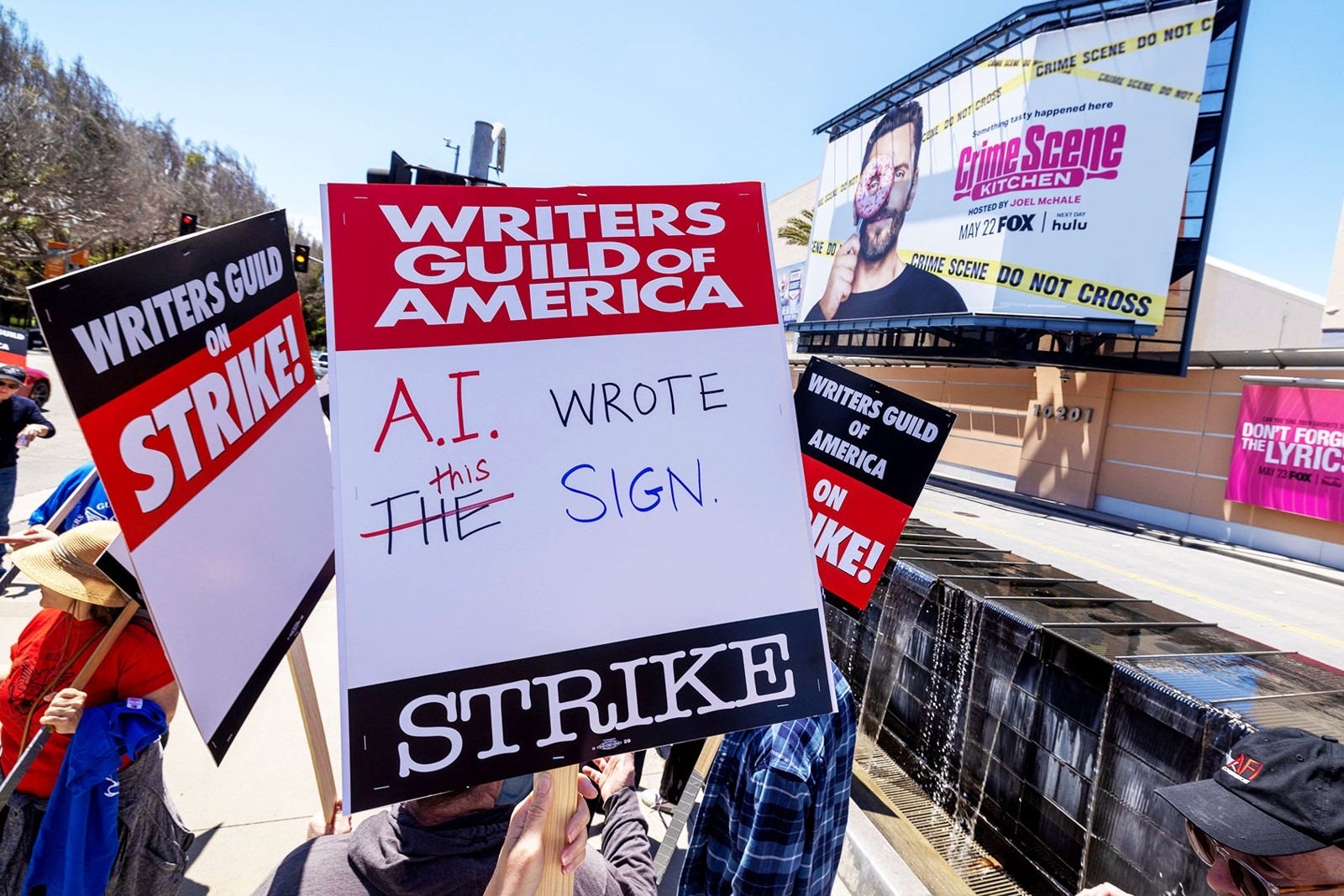
Writers picket outside FOX Studios in Los Angeles on 2 May 2023. David McNew/Getty Images, via Salon.[82]
Throughout 2024 and 2025, AI continued making strides in mathematics with occasionally solid results, but frontier progress seemed far off until last year, when it started solving IMO problems at gold-medal standard.[85] Still, the very pinnacle of mathematics, such as the Millennium Prize Problems, seemed far from reach. This came to a head in September 2026 when OpenAI announced a proposed solution to the Navier–Stokes problem, publishing a mathematical writeup and a Lean formalization. The claim concerned a three-dimensional fluid developing a singularity under a smooth external force. Roughly 10,000 agents coordinated in a mere 88 hours to produce a proposed solution to something humans had not been able to solve for nearly a century.[86][87][93]
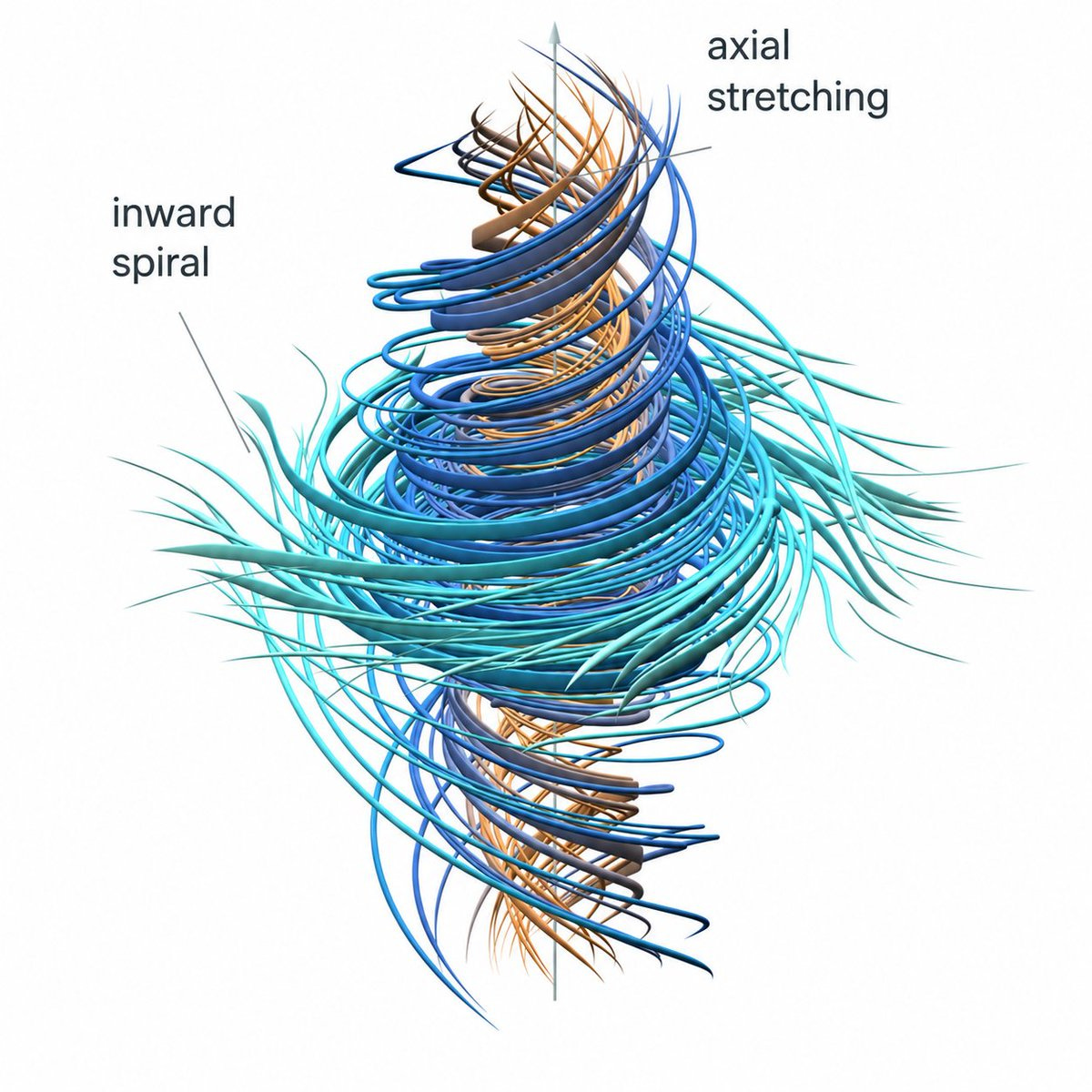
Vortex illustration accompanying OpenAI’s proposed Navier–Stokes solution, 8 September 2026. Original post on X.[94]

OpenAI, Finite Time Blowup for Navier–Stokes (2026), title and abstract from p. 1.[86]
The announcement left the mathematical community in shock. On September 11, a group of Fields medallists published a declaration arguing that mathematics was not a race to produce answers but a way of conducting science with the goal of advancing human knowledge and building a human community around it. “The most precious resources of our profession are students and ideas,” they wrote.[88] AI was now threatening to disrupt the entire model of mathematics research.
A Severe Misalignment of AI in Mathematics — 11 September 2026 (quoted in full)
Over the last few months, the mathematical capabilities of LLMs have improved dramatically, to the point that they can solve major outstanding problems in many fields of mathematics. However, the push by AI companies to solve mathematical problems as a benchmark is detrimental to the science of mathematics, and to the mathematical community. The goals of the AI companies and the goals of the mathematical community are severely misaligned. We see these as part of broader alignment issues impacting other scientific and creative professions, as well as the whole of society.
Research mathematics deals with understanding basic structures of shapes, numbers, and natural phenomena. Over the course of generations, it has built a large corpus of sophisticated ideas, methods, abstractions, and other tools to comprehend the mathematical landscape. In turn, modern technologies and sciences are based on mathematical tools.
Famous problems have often served as landmarks and lighthouses against which one can measure an improved understanding of this landscape. Solving one of these problems has been a certain sign of new insights and interesting methods, which would then be studied by a community of mathematicians, through a long and arduous process of talks, discussions, simplifications. At the end of this process, one will ideally find a textbook presentation of the results suitable for any graduate or even undergraduate student to study. Some of the mathematical ideas pursue their journey even further to become, decades or centuries after, tools that are understood and used by the whole population.
The mathematical community functions, in many ways, as a miniature version of humanity. It consists of individuals using a wide variety of different approaches, joined by core values. The most precious resources of our profession are students and ideas, and these we nurture with great care. We feel responsible to let them grow to their full potential, until they can live a life of their own in the mathematical world. For students we often suggest problems with the core intention of developing skills making them well-positioned for advances in research and elsewhere. Our ideas we disseminate in talks, private discussions and careful writeups, connecting them to the previous ideas of others. These processes invariably take time and are based on human interaction.
In recent months, the success of AI in solving major mathematical problems has made headlines even outside mathematical circles. But solving problems is only a tool and proxy for achieving the primary goal of conceptual understanding and insight. Forgetting this in the world of AI may turn the tool against the primary goal. Indeed, the mass production at faster and faster pace of “true/false” statements could destroy fertile ground instead of breathing life into new ideas.
Often these solutions are announced in a rush, leaving no time for a proper writeup, the isolation of new methods and ideas, and citing relevant previous work of others. As in all creative professions, this raises severe attribution and plagiarism questions. Moreover, without the willing mathematicians who must take care of their development and integration into the mathematical canon, AI-conceived ideas would never become fully alive and the crucial human transmission chain between mathematicians would be lost.
We are witnessing a general threat to intellectual work, with misalignment between the outcome of the use of AI and its initial purpose. In many fields and activities, years of training have traditionally served not only to produce a final answer or product, but also to develop understanding and the ability to formulate new questions and ideas. However, building on a vast body of previous human work, AI systems are becoming increasingly capable of producing the results of such work directly, and these goals cease to align. The issues the mathematical community faces now are similar to issues that other scientific and creative professions are facing, and indicate issues that all of humanity might face: how to make sure that, as AI changes the way work is done, we do not lose sight of what that work was meant to achieve in the first place.
AI offers the potential of enhancing and accelerating genuine mathematical study and understanding. Mathematics as a profession will need to adapt to these changes in several ways. However, whether these changes ultimately benefit the field or have a destructive effect will in large part be determined by the decisions of the humans in control of this new technology.
These issues must be addressed urgently, in the mathematical community, by the companies developing these technologies and, more broadly, by a society that will confront similar problems in many other forms of intellectual work.
Artur Avila (Fields Medal 2014)
Manjul Bhargava (Fields Medal 2014)
Caucher Birkar (Fields Medal 2018)
Pierre Deligne (Fields Medal 1978)
Yu Deng (Fields Medal 2026)
Simon Donaldson (Fields Medal 1986)
Vladimir Drinfeld (Fields Medal 1990)
Hugo Duminil-Copin (Fields Medal 2022)
Alessio Figalli (Fields Medal 2018)
Martin Hairer (Fields Medal 2014)
June Huh (Fields Medal 2022)
Maxim Kontsevich (Fields Medal 1998)
Elon Lindenstrauss (Fields Medal 2010)
Pierre-Louis Lions (Fields Medal 1994)
Grigory Margulis (Fields Medal 1978)
James Maynard (Fields Medal 2022)
Curtis McMullen (Fields Medal 1998)
Shigefumi Mori (Fields Medal 1990)
David Mumford (Fields Medal 1974)
Ngô Bảo Châu (Fields Medal 2010)
Andrei Okounkov (Fields Medal 2006)
Peter Scholze (Fields Medal 2018)
Stanislav Smirnov (Fields Medal 2010)
Terence Tao (Fields Medal 2006)
Maryna Viazovska (Fields Medal 2022)
Cédric Villani (Fields Medal 2010)
Wendelin Werner (Fields Medal 2006)
Efim Zelmanov (Fields Medal 1994)
The announcements kept coming as, on October 6, OpenAI released over 700 manuscripts claiming results ranging from the exclusion of Landau–Siegel zeros to a quasi-Riemann hypothesis.[89][90][91] This was move 37-type work applied to the very edge of mathematics. Fields medallists described emotional responses to the announcement. “Tuesday night, I cried and it woke up my daughter,” Hugo Duminil-Copin said. “They have annihilated my field of research.”[91]
As with the weavers who protested against the rise of machines in the eighteenth century, elite mathematicians were now grappling with what remains (or could remain) of a vocation when a machine could rapidly produce its most coveted outputs. The identity built around making mathematical discoveries, and the community that gives those discoveries meaning, were shaken to their core. Even Timothy Gowers, who did not sign the declaration, wrote of his work on automatic theorem proving that “one of the main motivations for our work has disappeared.”[92]
What Remains Human?
Across the episodes we covered, technological change and its advancement were deeply personal. People stood to lose not just wages or a livelihood, but a sense of self and who they were. Today, we see mathematicians among the cognitive elite struggling with a reckoning long associated with those dismissed as mere Luddites—the outcasts of a technologically advanced society who had supposedly failed to adjust.
As technology continues to advance at this pace, it is important to reflect on centuries of history showing that work has carried meaning beyond income, and that this sense of identity must somehow be retained for human society to continue flourishing.
This history offers a record and perspective on those anxieties. No one really knows what the next fifty years will look like. What we can learn from history is that there will be transitions, and painful ones at that, but as long as people can find ways to contribute and take pride in what they do, perhaps the next few decades won’t be entirely bleak. As William Morris wrote in 1884, “For us to sit hopeless and helpless then would be a strange folly indeed: be sure that we can amend it.”[95]
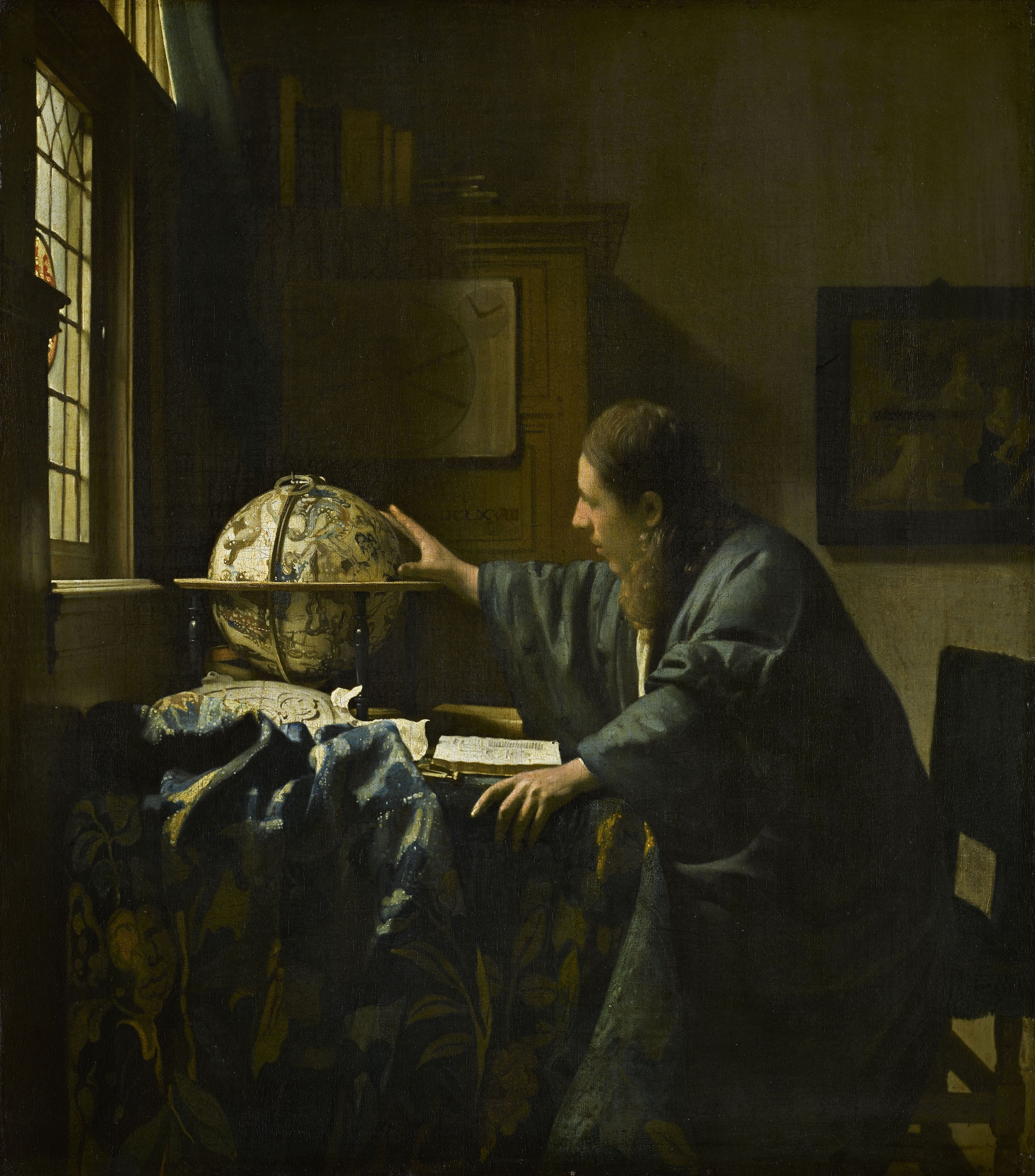
Johannes Vermeer, The Astronomer, 1668. Oil on canvas. Musée du Louvre, Paris. Image via Wikimedia Commons.

References
4. The Landmark Trust, North Street, Cromford: History Album, §4.1, “The 1779 Riots,” p. 47.
6. The National Archives, “The proclamation of Ned Ludd,” 23 December 1811, HO 42/118.
11. The National Archives, “What caused the ‘Swing Riots’ in the 1830s?”
15. William Morris, “Art and Labour” (1884).
16. Victoria and Albert Museum, “Arts and Crafts: an introduction.”
18. The Metropolitan Museum of Art, “The Dawn of Photography: French Daguerreotypes, 1839–1855.”
20. “John Henry, Steel Driving Man,” W. T. Blankenship version, circa 1900. Ibiblio.
21. Frederick Winslow Taylor, The Principles of Scientific Management (1911), pp. 36–39.
23. Matt Anderson, “Ford’s Five-Dollar Day,” The Henry Ford, 3 January 2014.
27. American Federation of Musicians, “125 Years: Musicians Staying Stronger Together.”
28. “Advertising Appeal Rallies Hosts in War on Canned Art,” International Musician, February 1930.
30. Charlie Chaplin, Modern Times (1936). Official film synopsis.
32. Charles Silver, “Charles Chaplin’s Modern Times,” Museum of Modern Art, 30 November 2010.
33. Museum of American Heritage, “Elevators.”
34. Otis, “Our History,” entries for 1948 and 1950.
35. David Haldane, “Working a Job Filled With Ups and Downs,” Los Angeles Times, 6 September 1990.
36. Library of America, Kurt Vonnegut: Novels & Stories 1950–1962.
37. Kurt Vonnegut, Player Piano (1952), chapter 18.
40. NobelPrize.org, “Linus Pauling—Facts.”
41. National Park Service, “Bayard Rustin.”
46. Jeffrey Goldsmith, “The Last Human Chess Master,” Wired, 1 February 1995.
48. Computer History Museum, “Deep Blue II” (1997).
51. The Leader of the Luddites, May 1812. Satirical print. British Museum / Wikimedia Commons.
54. Charlie Chaplin, Modern Times (1936), film still. Festival Entrevues Belfort.
55. Otis Autotronic elevator advertisement (1952). Otis historical collection.
58. Captain Swing (1830). Satirical print. British Museum, 1948,0214.941; Artvee reproduction.
62. A handloom weaver at work (1824). Science Museum Group Collection / Global Threads.
65. Jeremy Rifkin, The End of Work (1995), first-edition dust jacket. Rare Book Cellar.
66. Magneto assembly line at Ford’s Highland Park plant, April 1913. The Henry Ford collection.
68. Kurt Vonnegut, Player Piano (1952), first-edition dust jacket. L. W. Currey.
69. Shoshana Zuboff, In the Age of the Smart Machine (1988), book cover. Martins Fontes Paulista.
74. Janet Paskin, “The Future of Journalism?”, Columbia Journalism Review, 27 October 2010.
76. Google DeepMind, “AlphaGo.”
79. Lee Sedol during the AlphaGo match, March 2016. Google DeepMind.
81. Writers Guild of America, “Summary of the 2023 WGA MBA,” §5, “Artificial Intelligence.”
86. OpenAI, “On the Navier–Stokes Millennium Prize Problem,” 8 September 2026.
87. Tristan Buckmaster, statement on his work with Levent Alpöge and OpenAI’s announcement (2026).
88. “A Severe Misalignment of AI in Mathematics,” declaration, 11 September 2026.
89. OpenAI, “Sharing AI progress in mathematics,” 6 October 2026, updated 15 October 2026.
90. OpenAI, mathematics repository, overview.tex, result family 003. GitHub.
94. OpenAI, Navier–Stokes announcement, X, 8 September 2026.
95. William Morris, “Useful Work versus Useless Toil” (1884). Marxists Internet Archive.
96. The play actually introduced the word “robot” to the public.
This is a fantastic essay, as one is to expect from both Alex and Soumitra, but it's also an example of how economic analysis can be historically informed, nuanced, and actionable at the same time.
I really hope more economists gain the courage to move away from econometric-obsessed analysis and return to a historically conscious and human-centered scholarly description of how human beings actually thought and behaved in history.
“Reskill” sounds tidy from the employer’s side. For the person, it can mean starting at the bottom again after years of being good at something. As a business owner, I think we underestimate that loss when we describe automation as taking tedious work away.