
What will be scarce?
The economics of structural change and the post-commodity future of work

Starbucks is a huge company (market cap of $112 billion) that sells one of the most standardized products in the modern economy. Making a cup of coffee or even one of the fancy specialty drinks is very easy to mechanize and reproduce. If the entire economy is soon to be automated, with labor being replaced with increasingly more sophisticated capital, Starbucks should be a canary in the coal mine—the technology for removing labor from its stores and replacing it with automated capital has been around for years. Over the past few years, Starbucks has done exactly that: in efforts to increase thin margins, management has automated more and more of the coffee-making business and instituted tightly mechanized processes for delivering it to customers. But instead of increasing automation, the opposite has happened. After trying to streamline the store experience with fewer workers and more automation, the company concluded that this had been a mistake. CEO Brian Niccol said that ``handwritten notes on cups’’, ceramic cups, and ``the return of great seats’’ had led more customers to ``sit and stay in our cafes’’, showing that ``small details and hospitality drive satisfaction.’’ More baristas are being hired per store and automation is being rolled back.
Economics is the study of decision-making under constraints, i.e., scarcity. If advanced AI brings material abundance—if machines can produce many if not all forms of human production at very low marginal cost—does economics become irrelevant? No, we will still have scarcity, but the kind of scarcity that matters will change. Ultimately the answer to any question about the future economics of advanced AI begins with identifying what becomes scarce. After answering that question, the rest of the analysis is pretty straightforward. In this essay I’m going to explore what becomes scarce when automation can replicate many if not all human production, and what that may mean for the types of jobs that emerge.
Before industrialization, it was difficult to separate a product from the person who made it. The weaver who made your shirt, the baker who made your bread: you personally knew them, and their skill and reputation were tied to the product that they sold. Economic transactions had a distinct social component that was innately linked to the consumption experience. The industrial production process changed this by breaking craft into standardized, repeatable steps. Performed by workers based on predetermined and regularized steps, capitalism produced something new: the commodity form, in which a product’s value lies in the product itself, detached from whoever made it. A table is a table, a phone is a phone. The screen that you’re reading this essay on was designed in one country, manufactured in another, using components from around the world. But none of this matters for the experience of buying and using the device.
Marx described this process in intentionally loaded language. The commodity form, he argued, was built on exploitation: the ability to pay workers less than the value of what they produce. They were able to do this because the capitalist production process was based on alienation: severing workers from the product of their labor, from the process of making it, and ultimately from each other. What had once been a person’s craft became abstract ``labor power,’’ a factor of production to be bought and sold like raw materials. Marx saw this as capitalism’s deepest pathology. But to economists, and to the world writ large, the commodity form was an engine of extraordinary prosperity. If production was no longer tied to specific people, it could be disaggregated, reorganized, shipped across oceans, and scaled in ways that turned few resources into vast riches. Both things were true at once: the commodity form created enormous wealth and prosperity, but it made the human behind any specific product invisible, and ultimately, replaceable.
This is most people’s mental model of what AI will do to the economy. If a machine can produce anything a human can, write the brief, generate the image, compose the song, determine the diagnosis from a radiology scan, then the human will be replaced across all facets of production and jobs will simply disappear. Labor will be replaced with capital. David Autor and Neil Thompson push back on this in an important recent paper. They argue that AI won’t simply eliminate jobs; it will reshape the economic value of human expertise. Their framework distinguishes between expert and inexpert tasks within any given occupation. When automation removes the simpler tasks (as accounting software did for bookkeeping clerks), the remaining work becomes more specialized, wages rise, and fewer workers qualify. When it removes the harder tasks (as inventory management systems did for warehouse workers), the job becomes more accessible, employment expands, and wages fall. Same technology, opposite labor market outcomes, depending on which part of the job gets automated.
But Autor and Thompson also consider a starker possibility: that AI advances to the point where human expertise loses its economic value altogether. Under this scenario, AI will eliminate labor scarcity and produce what Herbert Simon once called ``intolerable abundance.’’ Automation of production will no longer involve managing a workforce transition, for which we have prior episodes of automation to rely on. We will need tools to maintain social organization, income distribution, and democratic stability without the labor market that has historically held these together.
I want to consider a different scenario, one where automation can replicate human production and the commodities that it produces (a big if!!!), but human labor does not disappear. How could this be the case? A lot of analysis takes the economy as given: there is a set of jobs and a set of goods/services produced by the economy. If the same set of goods/services can be produced by cheaper machines, then these machines replace humans and the jobs disappear. But the economics of structural change, combined with deep-seated features of human preferences, suggests something different: as people get richer, they don’t just want more commodities. They want things that aren’t commodities in the standard sense of the word. The social aspects of products such as the relationships, the status, and exclusivity—what Rene Girard called the mimetic properties of desire—become much more relevant once people’s basic needs are satisfied. And the demand for these properties will bring the human element back into the production process, and with it, the jobs.
If this is right, then AI won’t just automate the commodity economy. It will trigger the emergence of something new: a post-commodity economy, where a growing share of expenditure goes toward goods and services whose value is inseparable from the human who provided them. The same economic forces that moved 40% of the American workforce off farms and into factories and offices will move workers out of automatable commodity production and into what I’ll call the relational sector. By this I mean the human-intensive, provenance-rich, sometimes artisanal part of the economy where the human aspect is part of the value of the good or service itself. The economics of scarcity won’t disappear, it’ll just relocate.1
This is not the first time this argument has been made (see here by me, here by Seb Krier, here by Adam Ozimek and here by Philip Trammell). The goal of this post is to make this argument precise. I’ll start with what we know about how economies have historically responded to massive productivity shocks, the economics of structural change. Then I’ll introduce the new ingredient: a behavioral microfoundation, rooted in mimetic preferences that generate a desire for exclusivity and status, that explains why artisanal goods (where the human element is directly tied to value) have especially high income elasticity. I’ll work through a simple model that generates a clean prediction: automated sectors shrink as a share of GDP; relational sectors grow. And I’ll connect this back to the question I raised in a previous post about whether AI could lead to negative economic growth. This framework pushes further against that thesis.
My claim here is narrower than the strongest version of the labor-share story. I am not claiming that labor’s aggregate share must rise, or even that it must remain at its current level. It may well shrink as automation progresses. The claim is about sectoral reallocation in rich economies: as AI makes commodity production cheap, spending and employment shift toward high-income-elasticity sectors where human involvement still carries value. In other words, labor share can fall and the relational sector can still remain a substantial part of the economy. But importantly, the inherent properties of demand for the relational sector also ensure that labor remains a substantial share of the overall economy (i.e., it will not shrink to zero). The companion technical note works through the formal version of the claims in this post; please take a look if you’re interested in the more precise economic argument.
But I also want to underscore that this framework works best for the developed world, where rising incomes can fund the transition. For the developing world, whose economies have been built on producing commodities for rich countries, the picture is more complicated, and potentially more worrying.
From farms to factories to…
Economics has a name for what happens when a new technology makes one sector dramatically more productive: structural change. The canonical example is agriculture. In 1900, about 40% of the American workforce was employed in farming. Today it’s less than 2%. Did people stop eating? No, if anything they’re eating much more. Large scale automation made farmers—and eventually factory farms—much more productive. Agricultural production boomed and prices fell. But because people can only eat so much, the share of income spent on food went down as people got richer, and workers moved to manufacturing and then to services. The simultaneous fall of prices and reallocation of labor to another sector led to the perhaps non-obvious result that the more productive, automated sector became a smaller share of the economy despite serving and producing more. The less productive sector (services) where costs had not fallen—and in fact have risen—became a larger part of the economy. This is known as Baumol’s cost disease, and you can see the transformation for Taiwan in Figure 1 below.
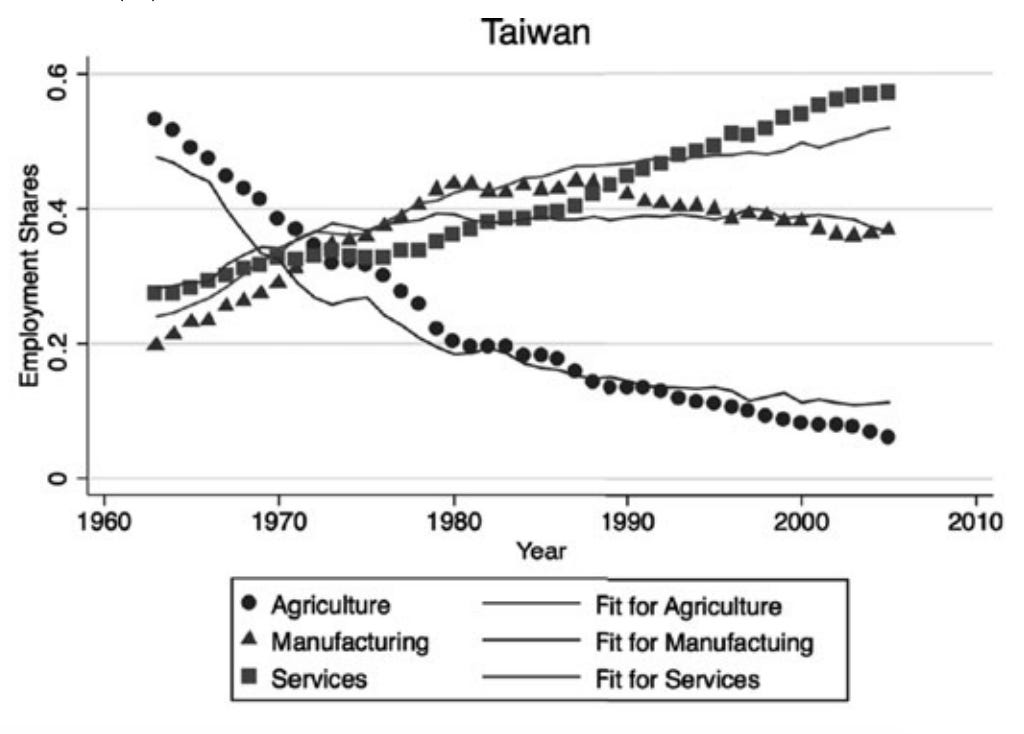
The formal economics of this process were laid out beautifully in a 2021 Econometrica paper by Diego Comin, Danial Lashkari, and Mart’i Mestieri (thanks Peter McCrory for pointing me to it). Their key insight is that demand is nonhomothetic: as people get richer, they don’t just buy proportionally more of everything. They shift their spending toward sectors with higher income elasticity, goods whose demand grows faster than income. Agriculture has low income elasticity (you can only eat so much); services have high income elasticity (there’s always a better restaurant, a more engaging experience, a more attentive doctor). Their framework matches the historical data well, capturing the decline of agriculture, the hump-shaped rise and fall of manufacturing, and the steady ascent of services.
The key point in Comin et al. is that the main mechanism is not Baumol’s cost disease by itself. It is that lower prices in automated sectors raise real income, and rising real income shifts demand toward sectors with higher income elasticity. Baumol’s cost disease then reinforces the shift when those sectors remain relatively hard to automate. The reason they may be ``hard’’ to automate can be due to technical constraints, as has been the case in the past, or because the value of those sectors rests on them not being automated in the first place, e.g., the relational sector where not being automated is part of the value proposition. In other words, even if rates of automation were similar across sectors, we would still expect the relational sector to become more important if it is where richer households want to spend more of their money.
How does this relate to AI-driven transformation of jobs? Comin, Lashkari, and Mestieri estimate that income effects account for over 75% of the observed patterns of structural change. Price effects, the standard story that automated sectors get cheap so people buy other stuff, account for only about a quarter. The dominant force is actually pretty simple: as people get richer, they want fundamentally different things.
Importantly, this is already visible in how rich households spend. In the 2022 BLS Consumer Expenditure Survey, households in the highest income quintile spent about 4.3 times as much in total as households in the lowest quintile. But the ratios are much larger in categories with a strong relational component, such as in-person dining, entertainment, education, etc. Rich households, in other words, do not just buy more stuff. They shift their spending toward goods and services where the human element, the experience, or the social meaning matters more. This is also exactly the pattern Joachim Hubmer documents in ``The Race Between Preferences and Technology.’’ Using household data on the universe of consumer spending, he shows that higher-income households spend relatively more on labor-intensive goods and services as a share of total consumption; he interprets this as evidence of nonhomothetic preferences, so that economic growth raises demand for labor-intensive sectors through an income effect even as other technological forces push in the opposite direction.
If advanced AI dramatically reduces the cost of producing a wide range of goods and services, this logic predicts a structural transformation. Automated sectors will shrink as shares of the economy. The sectors with higher income elasticity will grow. The question is: which sectors/goods will have high income elasticity in a post-AGI world?
The relational sector and desire
Here I think it’s useful to have a closer look at the determinants of human preferences and desire. Economists typically model demand as if preferences are formed in isolation; the “utility” I get from a good, service, or experience is determined by its hedonics (e.g., how good did the coffee taste, how quickly did I get the coffee after ordering it).2 This makes sense when people’s budget constraints bind when it comes to meeting basic needs, e.g., for food, shelter, and clothing. But once those needs are met, a different force starts to shape what people want, and even becomes dominant. René Girard called it mimetic desire: the idea that we don’t desire objects only for their intrinsic properties, but because other people desire them as well. We want what others want, and we want it even more when they can’t have it—for status, social capital, reputation, etc. Desire is not just a relationship between a person and an object; it is also a function of what other people desires.
This idea was not Girard’s alone—it runs through centuries of thought about human nature. Augustine wrote about the libido dominandi, the lust for mastery, as a defining feature of desire. To him, people’s motivations were intimately linked to the pleasure of possession that others are denied the same good. Hobbes, in Leviathan, placed competition for glory and honor at the center of his account of human conflict—people were not just motivated by material comfort but ``eminence’’ over others, and this drive is never satiated because it is inherently comparative. Rousseau went further still. In his Discourse on the Origin of Inequality, he distinguished amour de soi, a basic instinct for self-preservation, from amour propre, the need to be regarded as superior by others. Amour propre is the engine of social life and, for Rousseau, the source of most of its miseries: once people begin to compare themselves, they derive joy from feeling superior and pain from feeling inferior, and this comparison ratchets upward without limit.
Cultural critic Dave Hickey put this in plainer terms. In his excellent collection of essays ``Air Guitar: Essays on Art & Democracy’’ (thanks Tim O’Reilly for the pointer), Hickey notes that people in developed economies often pay more for objects than what they’re worth in a functional sense. One of his examples is an Armani suit. Nobody who buys Armani is buying a better way to keep warm. They’re buying the brand, the relationship to the story behind Armani, its meaning, its reputation, the fact that other people know what it is and want it. Hickey’s point is that desire is not just based on what products but also what they mean. And that meaning, that provenance, is difficult to commodify and manufacture at scale---the fact that the good is scarce is exactly what gives it meaning. While Armani uses industrial machines to make their ready-to-wear lines, the high-end suits feature considerable human involvement. Given advances in machines, the industrial process can certainly replicate the functional aspects of a high-end suit, including the aesthetics. But the human remains in the loop precisely because that is what gives the suit its value.
Why is this mimetic, relational dimension of desire relevant to the framework of Comin et al.? Because it is comparative, and therefore hard to satiate. Goods with this property should have especially high income elasticity as incomes rise.
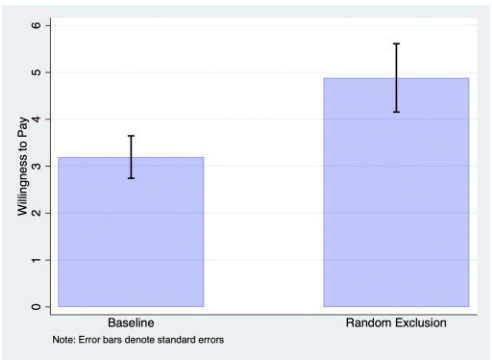
Kristof Madarasz and I provided support for the mimetic dimension of preferences in the context of basic economic exchange. We first developed a formal model where a person’s desire for a good increases in how much others want it but can’t have it. This predicts that people will value things more when there’s genuine exclusion, when access for a specific object is scarce and others are left wanting. In our experiments, willingness to pay roughly doubled when subjects learned that a random subset of people would be excluded from the product (Figure 2 below), even though the product itself was identical. This wasn’t status signaling (subjects were anonymous) or a scarcity heuristic (exclusion was random). It was purely driven by a pure preference for having something others don’t.
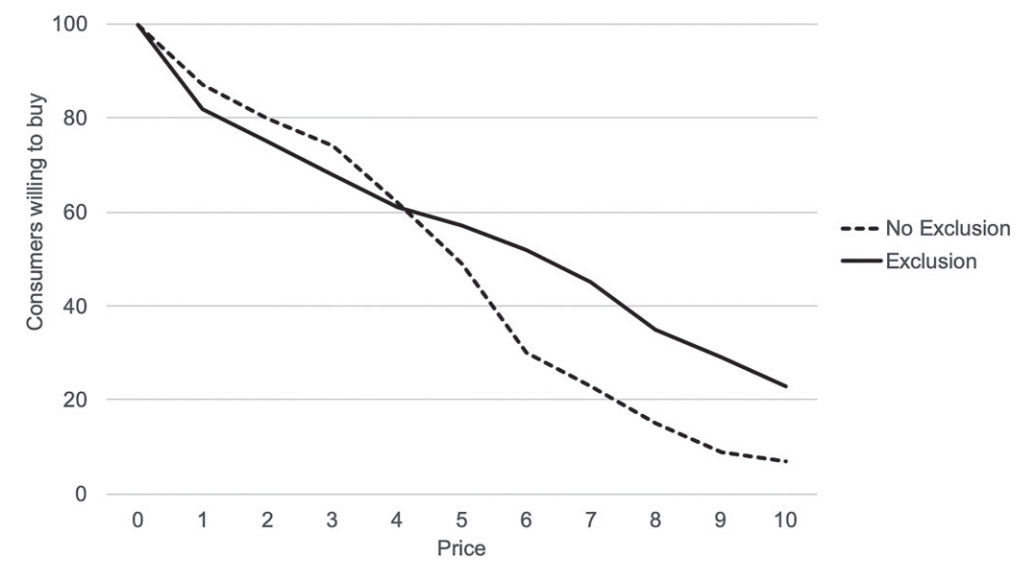
We also ran an experiment where we elicited the actual demand curves as a function of mimetic preferences. You can see how the demand curve shifts substantially to the right as the prospect of exclusion ramps up (Figure 3). And the effect is not small—median willingness again nearly doubles!
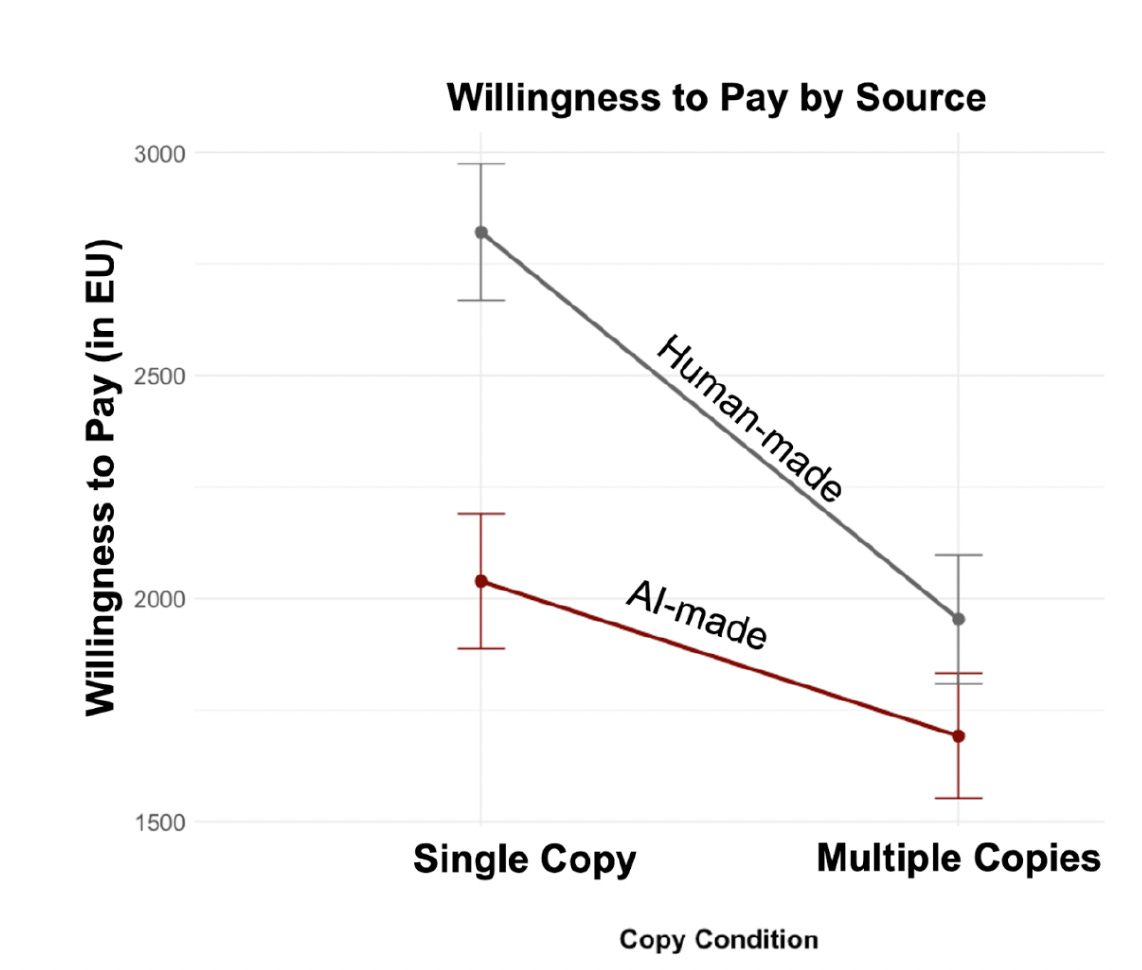
The critical link to AI comes from new work with Graelin Mandel. We find that AI involvement undermines the perceived exclusivity of a good; objects with AI involvement are perceived as inherently reproducible and non-unique. People bid for physical art prints that varied in described AI involvement. Human-made artwork gained 44% in value from exclusivity (one copy vs. many), but AI-generated artwork gained less than half that, only 21%. The mere involvement of AI made the work feel inherently non-exclusive, as if it could always be reproduced, regardless of how many copies were said to exist.
I want to stress that this extends well beyond artists and luxury craft. Walter Benjamin wrote about this in a different context, the ``aura’’ of a work of art, which mechanical reproduction destroys. But the economic logic goes beyond art. It extends to any category where the human element is integral to the value: teachers, nurses, therapists, childcare workers, trainers, hospitality, clergy, guides, and many forms of local services. In all of these cases the human being is not just an input into the production process. Their judgment, attention, memory, warmth, or presence is an integral part of the value. These are cases where, as Seb Krier put it, provenance remains scarce even in a post-scarcity world.
This matters for structural change because the mimetic component of preferences is inherently income-elastic. When you’re poor, most of your spending goes toward necessities where the identity of the producer doesn’t matter. As you get richer, a larger share goes toward goods where you’re not just buying the functional product; you’re buying the story, the scarcity, the feeling of having something that others want as well. This is what gives relational goods and services their high income elasticity: as incomes rise, the exclusivity premium becomes a larger share of total value, and that premium is something human-made goods can deliver.
An end of the commodity economy?
Let’s return to the commodity form. I defined it earlier: the abstraction of a product from the person who made it, the thing that made industrial capitalism possible. What happens to it when AI can produce the commodity itself?
The obvious answer is that the commodity form achieves its logical endpoint. A product with no human in it at all. But the less obvious answer, the one that comes from taking structural change seriously, is that AI doesn’t just perfect the commodity form. It also triggers the commodity form’s (in the strict sense) decline as a share of economic activity.
Here’s the mechanism more precisely. When AI automates commodity production, prices in that sector fall. That raises real income. If the goods and services people want more of as they get richer lie disproportionately in the relational sector, demand shifts in that direction. Baumol’s cost disease then amplifies the result: if the relational sector remains harder to automate, it becomes relatively more expensive and absorbs a growing share of total expenditure.
But in the context of AI automation, Baumol’s cost disease is a feature, not a bug. Saffron Huang made this point recently, in a very well-argued post about a potential positive future for AI-driven structural change.


The relative expense of human services stops being a budget problem and starts being a labor market solution. The ``stagnant’’ sector, the one that resists automation, is precisely where spending and employment grow. The relational sector gets more expensive because the commodity sector is getting cheaper, and that’s what keeps people employed.
What does this actually look like? Saffron painted a plausible and specific picture. Material abundance from automated manufacturing means goods are cheap. Most people’s spending goes to human-led services: today’s luxuries become the baseline for future consumers. As commodity production gets automated, income and employment flow toward the sectors with high income elasticity: what I am calling the relational sector, including the arts but also care, education, hospitality, therapy, personal services, craftsmanship, and community, where the human element is part of the value. The ``stagnant’’ sector absorbs a growing share of spending and jobs precisely because it can’t be automated. That is where the jobs are. If you’re interested in the mathematical model for this process, I’ve worked it out here. Here is a potential picture of what that may look like.
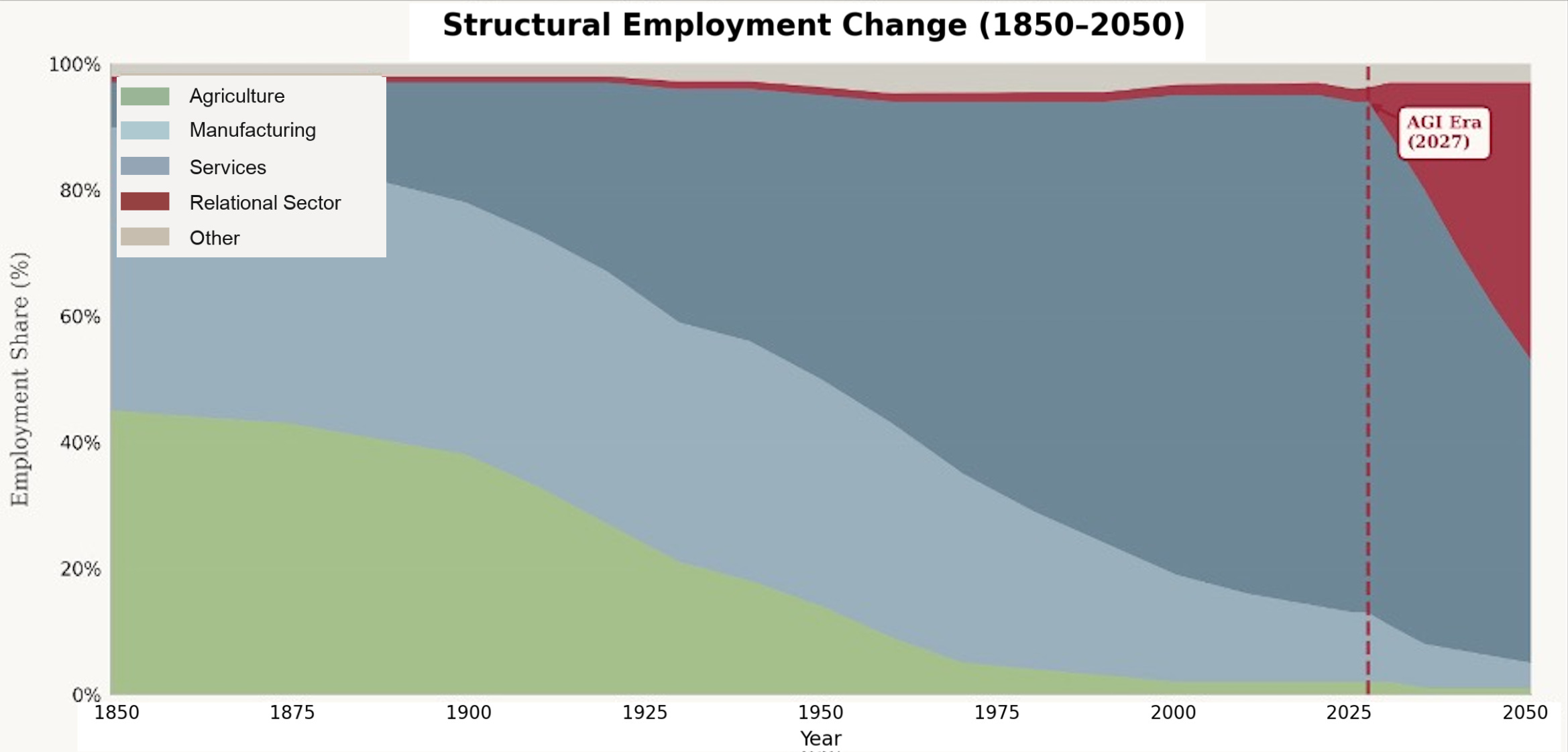
Admittedly, Marx would have found this outcome strange. But I want to be careful here. A product with a distinct human element is not the same thing as decommodified labor. A tailor who stitches your suit or a teacher who knows you personally may still be selling relational labor to capital. The social relations of production may remain fully capitalist even if the human aspect of the product becomes more economically salient.
So my claim is narrower. AI may reduce the commodity sector’s share of expenditure and increase the share going to goods and services where the human element remains visible and valuable. That is not the end of commodification in Marx’s sense. It is a shift in the composition of demand. Still, it matters for labor markets: the direction of structural change may be toward work that is, in some cases, more personal, more relational, and less interchangeable than what it replaces.
Demand collapse revisited
This connects back to something I’ve written about before and has been on many people’s minds, particularly since the release of the ``Citrini essay.’’ In my essay on whether advanced AI could lead to negative economic growth, I showed that if AI automates most labor and the wage share collapses, the economy could potentially shrink. The mechanism: the people with money (capital owners) are already satiated, while the people without money (displaced workers) can’t buy anything. Demand collapses because people who made the economy function by buying goods and services no longer have any money to do so.
The key equation from that post was:
Demand collapses when the multiplier shrinks (because labor share s_L falls) faster than baseline consumption kappa_0 can expand (because of satiation).
Mimetic desire pushes against this scenario because this aspect of demand is not quickly satiated. As highlighted above, the fact that the preference for status and exclusivity is comparative means that people will keep reallocating spending toward goods that satisfy it as incomes rise. The nonhomothetic CES framework captures this by allowing expenditure shares to keep shifting with income. That does not mean there is literally no ceiling anywhere; time constraints and other scarce complements still matter. But it does mean the economy has a much larger release valve than a simple satiation story implies.
Even if demand for automated goods hits a ceiling, demand for relational goods can keep growing over a very wide range. The structural reallocation acts as a release valve: the economy doesn’t need everyone to keep buying more automated stuff. It needs spending to shift toward the margins people care more about as they get richer.
The future of work
If the model is right, the durable jobs of the future won’t be about monitoring AI systems or prompt engineering. Those are transitional roles in the automated sector. The durable jobs will be in the relational sector, where the human element is the product itself.
Some already exist and are growing: nurses, therapists, teachers, boutique fitness instructors, personal chefs, bespoke tailors, craft brewers, live performers, spiritual guides, childcare workers, and many varieties of hospitality and care work. Others are emerging: experience designers, human-AI collaboration artists, provenance certifiers, community curators. Many haven’t been invented yet, just as six out of ten jobs people hold today didn’t exist in 1940.
The most common pushback I get when I say this is: ``but not everyone is creative, not everyone will be artists.’’ I think this misunderstands what’s being asked. You don’t need to be Picasso. You need to be the person whose involvement makes the product feel like it was made for someone, by someone. The economics of structural change tells us that when technology makes one type of production cheap, the economy doesn’t collapse. It transforms. It shifts toward the things that technology can’t make cheap. For AI, those things are exactly the ones where human involvement carries inherent, irreplaceable value.
An alternative perspective
I want to end by considering an alternative perspective. Philip Trammell’s essay considers the possibility of a future where labor is a luxury. In the essay, Trammell is asking an asymptotic question about whether labor’s aggregate share stays high in the limit as capital accumulates and machine-produced varieties proliferate. The focus of the current essay is different: in rich economies, what happens to sectoral expenditure and employment as AI makes commodity production cheap?
On that question, I think it’s worth taking a broader historical and theoretical perspective. First, the structural-change evidence says income effects do most of the work. The prevailing historical pattern is not just that sectors with fast productivity growth get cheap and shed labor; it is that as societies get richer, they reallocate spending toward different kinds of goods. That is the core result in Comin, Lashkari, and Mestieri: their model is built to explain the decline of agriculture, the hump-shaped rise and fall of manufacturing, and the long rise of services, and they find that income effects account for the bulk of within-country sectoral reallocation. Trammell is very good on the point that standard macro models underrate the possibility that labor could remain important, because they aggregate too much and often assume homothetic preferences. But I think the relevant question is not whether aggregate labor share rises. It may not. The relevant question is what sectors absorb expenditure and employment once commodity production becomes cheap, and whether the sector that labor is reallocated to still remains a substantial part of the economy.
Hubmer is helpful here because he shows that these two claims can come apart: higher-income households spend relatively more on labor-intensive goods and services, so growth itself tilts demand toward sectors with higher labor content, even while other technological forces push the aggregate labor share downward. And on the question of whether labor remains a substantial part of the economy, once can just look at what very rich people (e.g., billionaires) spend their time and money on today (thanks to Tom Cunningham for this point). Sure, there is a lot spent on capital and non-relational goods, but a huge chunk of time and money gets spent on ``relational’’ products: the rich buy handmade clothes, buy handmade art made by so-and-so, they eat handpicked, hand-prepared food, and they spend (maybe too much) of their time on various platforms trying to make sure that their thoughts are heard and discussed by other human beings. Renee Gigard would say that this is not a blip—it is due to a basic property of human desire.
Second, the history of artisanal decline needs to be read carefully. It is true that over the last two centuries a great deal of traditional artisanal employment disappeared. But that is not, by itself, evidence that demand for the relational sector is weak. What industrialization did was replace the functional output of many artisanal goods with much cheaper commodities. A machine-made shirt, chair, or phonograph could satisfy the core consumption need at a tiny fraction of the old cost, and for most households budget constraints still bound tightly enough that the cheaper commodity won. That historical pattern is therefore consistent with my argument. The question is what happens after the commodity becomes cheap enough. Structural change suggests that once basic commodity consumption is cheap and incomes rise sufficiently, expenditure shifts again—this time toward sectors where the human element is itself part of the value. So I do not think the historical decline of artisans is the last word here. I think it is one stage in a longer process.
Finally, the category of human goods is much broader than artists and authenticity goods. Education, care, hospitality, therapy, and various local services are, for reasons outlined elsewhere in this essay, categories where the value of the service is likely to be increasingly linked to the human providing them. The BLS Consumer Expenditure Survey shows that households in the top income quintile spent significantly more on these more relational categories than lower-income consumers, and even now these sectors are not small parts of the economy---together, they employ nearly 50 million people in the US. This gives some credence to the claim that the relational sector will be a substantial overall share of the economy post-AGI.
Thanks are due to Seb Krier, Kristof Madarasz, and Graelin Mandel, whose ideas shaped this essay. Thanks also to Tom Cunningham, Zoe Hitzig, Saffron Huang, Peter McCrory, and Tim O’Reilly for excellent feedback and conversations.
Note that I am not claiming that human labor will be the only thing that remains scarce. Land, energy, compute, and other fixed or quasi-fixed inputs may also absorb a great deal of income. My claim is only that human labor, even if no longer the dominant scarce factor, can still remain a substantial part of the economy because demand shifts toward sectors where the human element is itself part of the value.
This is not to say that economists have entirely ignored the social dimension of preferences. See, for example, Akerlof and Kranton’s work on identity economics, Alberto Bisin’s work on the impact of culture on preferences, amongst many others. There is also a long tradition in behavioral economics of modeling how context effects impact decisions and beliefs.
I’m not one of those people who spread doomsday scenarios, but this essay assumes that productivity gains will be distributed to the population. I’m not sure that’s the baseline scenario. In Europe, where income redistribution is much more pronounced, it’s more likely—but in the U.S.?
Thank you, always glad to see another take on this topic.
> “Trammell is asking … whether labor’s aggregate share stays high in the limit as capital accumulates and machine-produced varieties proliferate. The focus of the current essay is different: in rich economies, what happens to sectoral expenditure and employment as AI makes commodity production cheap?”
If this is the difference between our analyses, then surely mine is the one relevant to what will happen to the labor share in the future all things considered, no? Advanced AI won’t just (a) make it cheaper to produce a fixed set of “commodity” goods (shifting us toward artisanal goods via a price effect) and (b) make us richer all around (shifting us toward artisanal goods via an income effect, due to nonhomothetic preferences over {commodities, artisanal goods}). It will also accelerate the development of new varieties, an effect that doesn’t appear in the model in the technical note.
As for how important this effect is, something that seems worth reflecting on to me is that, even though
* at any point in time, cross-sectionally, the rich spend more than the poor on artisanal (what I call “human-intrinsic”) goods;
* this seems to have been true since the Dark Ages; and
* we’re hundreds of times richer than in the Dark Ages,
we still spend a share of ~0 on human performers. This is presumably (at least mostly) because we’ve invented new non-human-intrinsic things to spend on in the meantime. So technological development (at least on the “expanding varieties” front) seems capable of eliminating the tendency toward human-intrinsic goods that would have obtained if we’d all just “gotten richer” in the sense of having larger budgets with which to buy the goods available in the past [(b)] and even the fact that the relative price of commodities fell as well [(a)]. This ability for technological development to overturn (a) and (b) is also the main lesson I take from Hubmer, though he doesn’t frame his data as being about expanding varieties.
To my mind, the discussion here sometimes uses terms like “income elasticity” in a way that equivocates between getting richer on a fixed variety-set and technological progress that includes new varieties. E.g. in response to Hubmer’s finding that technological development has decreased the labor share despite (a) and (b), you say “on the question of whether labor remains a substantial part of the economy [in the future], one can just look at what very rich people (e.g., billionaires) spend their… money on today”. I don’t think this is right, any more than one would be able to learn about how much of his budget an American in 2026 with $40k would spend on “human touch” by looking at the “human touch” share of someone with say 40x the average income in Medieval England. Likewise, Comin et al. show that our collective "enrichment" drives a lot of structural change, but especially over the long run, I disagree with concluding that it's structural change in the same, labor-share-enhancing direction that you'd expect from looking at the cross-section.